Pack an Adapter and USB C Charger for Iceland Hostels
Pack an Adapter and USB C Charger for Iceland Hostels

Most modern phone and laptop chargers work in Iceland with nothing more than a plug adapter, since Iceland runs on Type C and Type F outlets at 230V, 50Hz. The single most useful item to pack is a multi-port USB-C charger that covers Type F, since it lets you charge several devices from the one outlet a dorm bed often provides. A power bank is a close second. High-wattage devices like hairdryers are the exception: skip the converter and use what the hostel provides.
TL;DR:
- Iceland uses Type C and Type F outlets at 230V and 50Hz; check that chargers accept 100 to 240V, since they then need only a plug adapter.
- Budget and rural dorms may offer just one or two shared outlets, so ask reception about charging access; private rooms usually have fewer guests competing.
- Pack a multiport USB C charger rated for 100 to 240V to charge several devices from one socket, plus a power bank under 100Wh.
- Hostels often supply hair dryers, while straighteners should be dual voltage; converters can overheat if they are undersized for the appliance.
- Check hostel rules before using a power strip, and charge valuables in a locked bag or locker instead of leaving them unattended.
Table of Contents
- Iceland’s plug types and voltage, explained simply
- What hostels actually provide at the outlet
- Your charging pack list for hostel dorms
- Keeping your devices and valuables safe overnight
- Hairdryers, straighteners, and other high-wattage gear
- Buying an adapter or charger after you land
- Fox Hostel: what we provide and how to prepare
- One thing worth remembering before you go
- Book a room that fits how you travel
- FAQ
- Sources
Iceland’s plug types and voltage, explained simply
Iceland uses two plug shapes: Type C, the two-round-pin Europlug, and Type F, the grounded Schuko plug with two pins and grounding clips on the sides. A Type C plug fits directly into a Type F socket, just without a ground connection, which is fine for small electronics but not for grounded appliances. Mains power runs at 230V and 50Hz, a meaningful jump for anyone arriving from a 100 to 127V country.
The only number that matters when packing is printed right on your charger. Look for “INPUT” or “AC IN” followed by a voltage range. If it reads something like 100 to 240V, 50/60Hz, your charger is dual-voltage and only needs a plug adapter, no converter required.
- Phone, laptop and tablet chargers: almost always dual-voltage, adapter only.
- Electric razors and toothbrushes: check the label, but most travel versions are dual-voltage.
- Hairdryers, straighteners and kettles bought at home: usually single-voltage and need either a converter or a substitute.
What hostels actually provide at the outlet
Charging setups vary a lot between properties, and knowing what to expect saves you from frustration on arrival.
- Newer, social-style hostels increasingly build in bedside USB-A or USB-C ports and multi-outlet panels near bunks, since many newer Icelandic properties now offer this as a standard feature.
- Budget or rural hostels may have just one or two shared outlets in a dorm room, and availability is never guaranteed even at properties that advertise USB charging, since coverage differs property to property.
- Private rooms tend to offer more reliable outlet access than shared dorms simply because fewer devices compete for the same socket.
- Common areas and kitchens often have extra outlets, but during peak evening hours they fill up fast with other guests’ laptops and cameras.
If charging matters to you, ask at the front desk when you check in. Staff can point you to lockers, extra outlets, or quiet corners with power, and our hostel amenities guide breaks down what to expect at different types of stays before you book.
Your charging pack list for hostel dorms
Dorm rooms reward travelers who pack light but smart. A cramped bunk with one shared outlet is not the place for a tangle of chargers.
- A Type C/F adapter, or a universal travel adapter that explicitly supports Type F grounding.
- A multi-port GaN USB-C charger rated for 100 to 240V, since it consolidates two or three devices into a single plug.
- A power bank with enough capacity for a full day of phone and camera use. Airlines generally allow power banks under 100Wh in carry-on luggage without extra paperwork, so check your bank’s rating before you fly.
- A compact, surge-protected power strip, only if the hostel’s rules allow it.
- Short USB-C cables and a small pouch to keep everything from disappearing into the bottom of your bag.
Pro Tip: Pack one multi-port charger instead of three separate wall adapters. It takes up less space and means you’re only fighting for one outlet, not three.
Keeping your devices and valuables safe overnight
Shared dorms mean shared risk, and a little planning goes a long way toward protecting both your gear and your electronics.
- Charge valuables inside a locked bag or hostel locker whenever one is available, rather than leaving a phone plugged in on an open shelf overnight.
- Avoid daisy-chaining adapters and power strips. A single multi-port charger handles the same job with far less risk of overload.
- Ask reception before plugging in your own power strip. Some properties restrict them for fire safety, and it is a one-minute conversation that avoids an awkward moment later.
- Inspect cables and chargers for frayed wires or cracked casing, and unplug devices once they finish charging instead of leaving them topped up all night.
Pro Tip: If a locker isn’t available, charging your phone inside your day pack, zipped and tucked under the bed, is a simple way to keep it out of sight while it tops up.
Our guide to preparing for a solo hostel stay covers more on keeping belongings secure in shared rooms, and groups traveling together can split up packing duties using a shared-essentials checklist so nobody forgets the adapter.

Hairdryers, straighteners, and other high-wattage gear
Hairdryers, straighteners, and travel kettles draw far more power than a phone charger, and that is exactly why converters cause problems. A heavy-duty voltage converter rated for a hairdryer is bulky, often expensive, and still risks overheating if it is undersized for the appliance.
- Hairdryers: most hostels, including many budget properties, supply one in the bathroom. Use it instead of packing your own.
- Straighteners and curling irons: buy a dual-voltage version if you travel with one often, since that avoids the converter question entirely.
- Kettles: skip bringing one. Shared kitchens typically have one, and a mismatched converter is not worth the fire risk.
If you absolutely must use a converter, check the device’s wattage on its label and choose a converter rated comfortably above that figure. Cheap, unbranded converters are the ones most likely to fail.
Buying an adapter or charger after you land
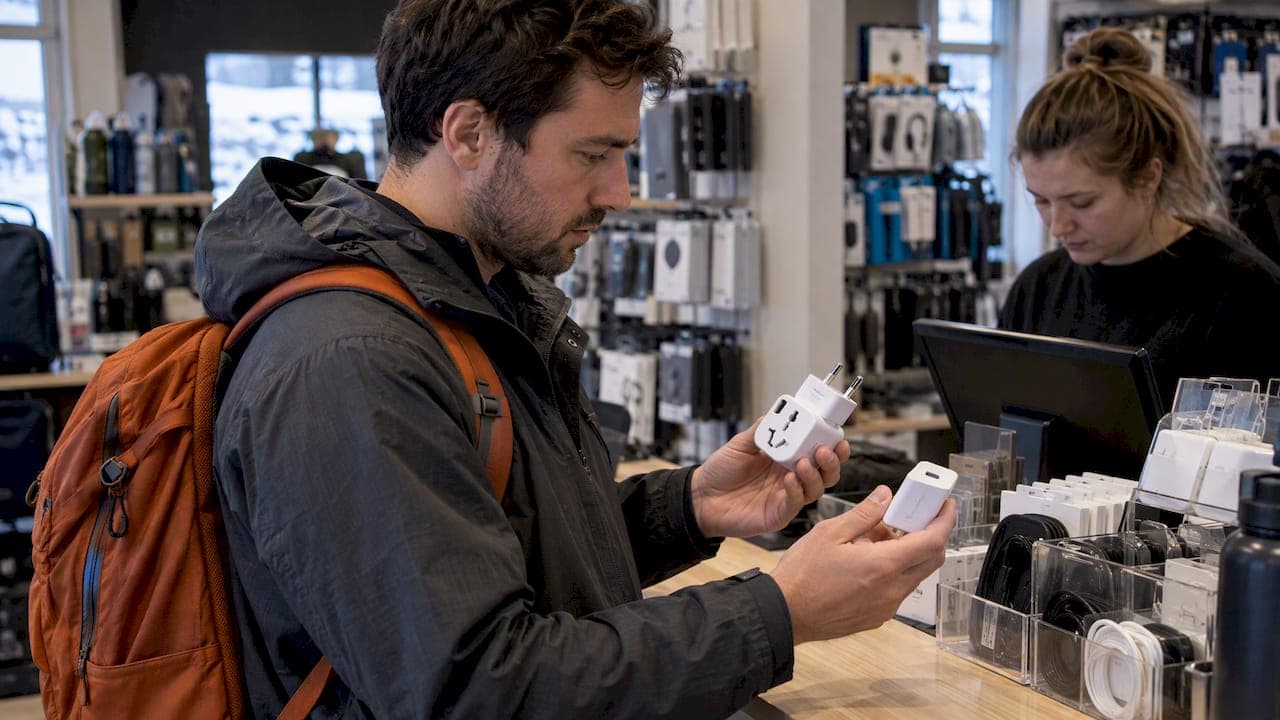
Keflavík Airport has electronics kiosks that carry basic adapters and power banks, but stock and prices vary by the day, so bringing one from home avoids relying on what happens to be in stock. If you land without one, Reykjavík’s electronics shops and department stores carry adapters, multi-port chargers, and power banks.
When buying locally, check for a few things before paying:
- Type F grounding pins on the adapter itself, not just a flat two-pin shape.
- A clearly listed USB-C PD wattage if you are buying a charger, so you know it can actually fast-charge your laptop or phone.
- A visible CE safety marking on the packaging or the device itself.
Fox Hostel: what we provide and how to prepare
We offer shared and private dormitories, breakfast, and an on-site pizzeria inside a converted barn on Iceland’s South Coast. Shared spaces make it easy to meet other travelers, and our setting gives you a quiet base for exploring the surrounding region.
If reliable bedside charging is a priority for your stay, mention it when you book, and our team can let you know what to expect in your specific room. Our rooms page has current details on dormitory types, and our piece on what a self-service hostel offers explains how amenities differ between hostel styles.

One thing worth remembering before you go
Pack the adapter and the multi-port charger before anything else. Everything else on this list is a nice-to-have, but those two items solve most charging headaches travelers run into in hostel dorms.
Keep your phone and camera charging somewhere you can see them, or lock them away if you step out, and don’t assume every bed has a USB port just because one hostel you stayed at did. A thirty-second question at check-in about outlets and lockers will tell you more than any packing list can.
— Siggi
Book a room that fits how you travel
We know a dead phone at the end of a long drive along the South Coast is nobody’s idea of a good trip, so pack smart and let the rest of the stay take care of itself.

- Check current room types and availability on our rooms page, where you can book individual beds or reserve a full room for your group.
- Traveling with a group? Our Group Bookings option lets you lock in a whole room together, and pairing your stay with a Rafting Adventure is an easy way to fill a free day nearby.
FAQ
Can you use US chargers in Iceland?
Yes, as long as the charger’s label lists an input range of around 100 to 240V, which covers nearly all modern phone, laptop, and camera chargers. You just need a Type C or Type F plug adapter since the US plug shape does not fit Icelandic sockets.
Will an American cell phone work in Iceland?
An unlocked American phone will charge and run fine in Iceland since the charger itself is dual-voltage. You only need a plug adapter for the socket shape; cellular service depends on your carrier and plan rather than on anything related to charging.
Can I use my iPhone charger in Iceland?
Yes, Apple’s charging bricks are dual-voltage and accept 100 to 240V, so an iPhone charger works in Iceland with just a plug adapter. No converter is needed for the phone itself.
Does Iceland use Type C or F plugs?
Iceland uses both: Type C, the two-pin Europlug, and Type F, the grounded Schuko plug. A Type C plug fits into a Type F socket without a ground connection, which works for most small electronics but not for grounded appliances.
Sources
- Iceland Plug Type, Power Plugs, Electrical Outlets, Wall Sockets & Travel Adapter - Type C, Type F
- Iceland outlets and plugs: Type F, 230V, 50Hz
- Electrical Outlets & Power Plugs in Iceland | Plug Types, Voltage & Adapters