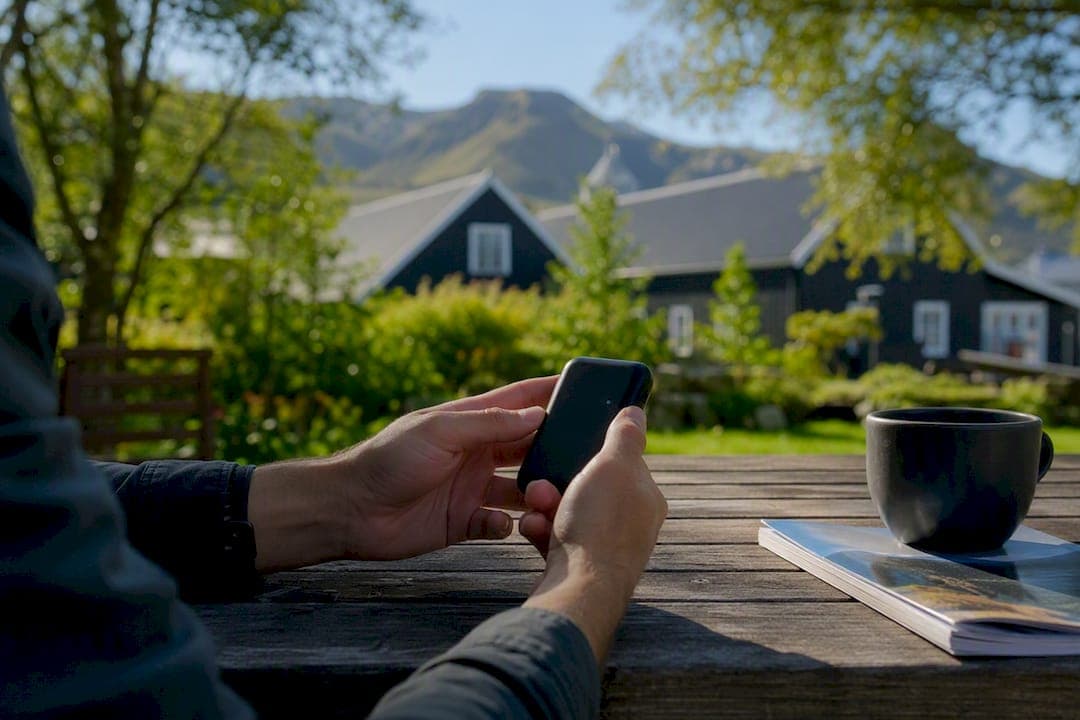
The Role of Location in Accommodation and Your Stay
The Role of Location in Accommodation and Your Stay

TL;DR:
- Location significantly influences travel satisfaction, explaining about 70% of guest happiness beyond price and amenities. Evaluating neighborhood safety, accessibility, proximity to attractions, and walkability predicts a better stay than star ratings alone. Prioritizing location insights, such as reviews and travel time, helps travelers choose accommodations that create memorable experiences.
Most travelers spend hours comparing prices and amenity lists, yet research consistently shows neither factor predicts satisfaction as well as where a property sits. The role of location in accommodation goes far beyond whether you can walk to a coffee shop. It shapes your mood, your daily logistics, the neighborhoods you absorb, and ultimately whether you come home raving about the trip or quietly disappointed. This article unpacks exactly how location works as the invisible engine behind great travel experiences, and what you should actually be evaluating before you book.
Table of Contents
- Key takeaways
- The role of location in accommodation: what you’re actually evaluating
- Why location shapes satisfaction more than price or amenities
- Trade-offs, event premiums, and the cost of a great address
- Urban vs. rural: what location type does to your experience
- How to evaluate location before you book
- My honest take on the location mistake most travelers make
- Where Fox Hostel’s location puts you ahead
- FAQ
Key takeaways
| Point | Details |
|---|---|
| Location drives satisfaction | Experiential location factors explain about 70% of peer-to-peer accommodation satisfaction variance, more than price or amenities. |
| Neighborhood vibe matters | The character and safety of the surrounding area shapes comfort, ambiance, and how much you genuinely enjoy your stay. |
| Event timing changes prices fast | Hotels near event venues can see rate differences up to 50% during peak periods, so early booking is critical. |
| Reviews reveal location truth | Sentiment in guest reviews reflects location experience more accurately than star ratings alone. |
| Rural stays offer different value | Nature-adjacent and rural properties trade urban convenience for authentic immersion, and many travelers find that trade well worth it. |
The role of location in accommodation: what you’re actually evaluating
In hotel industry terms, the concept being discussed here is often called locational utility, the measurable value a property derives from its physical position relative to demand generators, transport nodes, and neighborhood quality. Whether you call it that or simply “location,” the factors beneath it are specific and worth understanding.
Accessibility is the most straightforward piece. How far is the property from the airport, train station, or highway? If you land at midnight with luggage, a 90-minute bus ride to your hotel is not an inconvenience. It is the first memory of your trip. Properties with direct links to major transport arteries consistently outperform comparably priced competitors on arrival satisfaction.
Neighborhood character is subtler but arguably more powerful. A hotel can have a spa, a rooftop pool, and a Michelin-starred restaurant, yet if the surrounding streets feel unsafe or sterile, guests disengage. Conversely, a modest guesthouse on a street with a morning market, good coffee, and local foot traffic creates a richness that no in-room amenity can replicate.
The third factor is proximity to attractions. This one is obvious in theory but frequently underweighted in practice. When your accommodation sits within walking distance of the places you came to see, you gain something time-sensitive travelers rarely account for: spontaneous access. You go back to Reynisfjara Black Sand Beach a second time because it is 20 minutes away, not an hour. You do not have to plan every visit like a military operation.
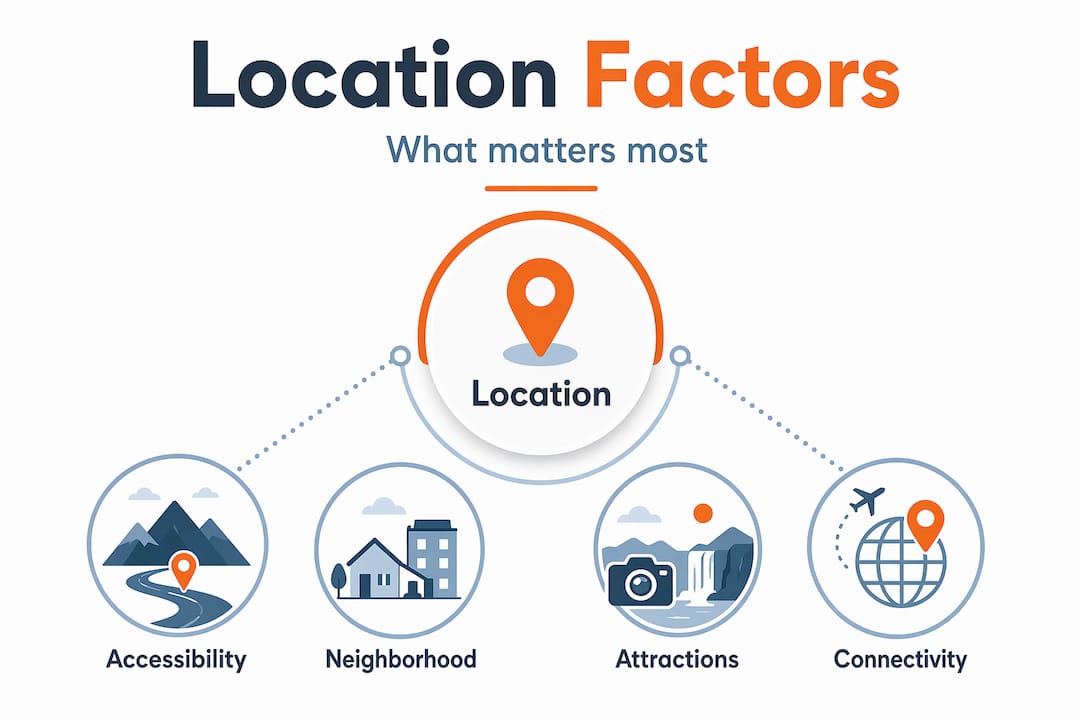
Finally, there is connectivity. This is not just about roads or trains. It is about the ease with which a location allows you to radiate outward. Some properties sit in places where day-trip logistics are effortless. Others require you to double back, fight traffic, or sacrifice half a day just to reach the next destination.
Pro Tip: When evaluating a property’s location, open a map and measure actual travel time to your three highest-priority destinations. Not the distance. The time, including traffic or transit waits. That number tells you the real cost of the location.
Why location shapes satisfaction more than price or amenities
Here is the finding that should reframe how you book: location factors explain around 70% of accommodation satisfaction variance in peer-to-peer stays, based on an analysis of nearly 110,000 Airbnb reviews. Price effects, once experiential and spatial factors are accounted for, become marginal.
That is not a small nuance. It means the traveler who paid 30% more for a central apartment likely ended up more satisfied than the one who saved money by staying on the outskirts, even if the cheaper property had nicer furniture.
The reason connects to what researchers call the experiential narrative of a location. Travelers do not just consume a room. They consume everything the room gives them access to. A stay in a neighborhood with authentic character, interesting streets, and quick access to local life produces memories. A stay in a generic zone with no ambient culture produces a functional night of sleep.
“Travelers pay not just for convenience but for coherent neighborhood experiences that create lasting satisfaction.” — Spatially Embedded Experience Economy
This plays out clearly in how people write reviews. A study analyzing 4,500 TripAdvisor reviews from Seoul hotels found that proximity to airports and the broader geographic feel of a location predicted emotional sentiment better than traditional star ratings. Guests who gave a hotel four stars still left glowing or lukewarm reviews depending almost entirely on how they felt about the surrounding area.
The practical implication is direct: sentiment analysis of location-focused reviews is a better booking tool than the aggregate star score. When multiple guests mention feeling safe walking at night, or describe the neighborhood as energetic and interesting, that information is worth more than a 4.3 versus a 4.1 rating.
Luxury travelers have caught on to this dynamic. Demand for authentic, place-connected stays is growing specifically because discerning guests recognize that the property is only part of what they are paying for. The setting, the neighborhood, and the sense that you are somewhere that feels of the place you came to visit. That is the real product.
Trade-offs, event premiums, and the cost of a great address
A desirable location is not without complications, and understanding those trade-offs is part of becoming a sharper traveler.
The most tangible issue is price volatility tied to events. Near major venues, hotel rates during peak event periods can vary by up to 50% depending on proximity and timing. This is not gradual inflation. It is a scarcity market that activates fast, sometimes within weeks of an event announcement. Properties in the walking zone sell out first and at the highest prices.
| Situation | What you pay | What you gain |
|---|---|---|
| Central location, peak season | Premium rate, limited availability | Maximum convenience, walkability, ambiance |
| Central location, off-peak | Standard rate, good availability | Same access benefits at reduced cost |
| Peripheral location, peak season | Lower rate, greater availability | Longer transit times, less spontaneous access |
| Peripheral location, off-peak | Lowest rate | Budget-friendly, but logistically demanding |
Beyond pricing, heritage and cultural districts carry their own friction. A survey of tourists in Denpasar found 49% dissatisfied with congestion despite high levels of spending, specifically because poor walkability and traffic made moving through the area exhausting. The location was compelling. Getting around it was not.
Walkability is one of the most underrated location factors for hotels and rentals. A property can be close to everything yet still feel inaccessible if the streets are clogged, sidewalks are poor, or the only way to reach nearby spots requires a car. When you evaluate a neighborhood, check its walkability and cycling scores, not just its proximity scores.
Pro Tip: Search for your target accommodation on Google Street View and look at the actual street, not the satellite map. Are there sidewalks? Is there parking pressure? What does the block feel like at street level? That five-minute check will tell you more than any amenity list.
Urban vs. rural: what location type does to your experience
Choosing accommodation in a city center versus a rural or nature-adjacent setting is not just a logistics decision. It is a decision about what kind of traveler you want to be during that trip.

Urban stays offer density. Everything is close. You can move fast, see a lot, and fill every hour without effort. But urban stays also come with noise, crowds, higher baseline costs, and a certain sameness. The room is a functional base. The city is the experience.
Rural or nature-adjacent accommodation works differently. Several things change immediately:
- The property itself becomes part of the destination, not just a place to sleep
- You spend more time in one area, which leads to deeper local engagement
- The absence of urban noise and stimulation creates a kind of mental reset that many travelers report as one of the best parts of the trip
- Authentic interaction with local communities and environments becomes possible in ways that a hotel on a tourist strip rarely allows
- Costs are often lower, which means the value-per-experience ratio can be dramatically higher
This connects directly to why nature-adjacent hostels attract a specific kind of traveler who is explicitly seeking location as the main product. They are not choosing the location despite fewer urban amenities. They are choosing it because of that quality.
The honest answer for most trips is that neither type is universally better. What matters is alignment: does the location type match what you actually want from this particular trip?
How to evaluate location before you book
Most people do this backwards. They find a property they like, then check the location. Flip that process. Start with the location, and let it filter which properties are even worth considering.
Here is a practical approach:
- List your non-negotiables first. What are the two or three things you must be able to reach easily? An airport for an early flight? A specific natural attraction? Public transit? Write them down before opening a booking site.
- Read reviews specifically for location language. Search review text for words like “neighborhood,” “walk,” “safe,” “noise,” and “access.” Location sentiment in hotel reviews reveals experiential quality that structured ratings miss entirely.
- Check the event calendar. If you are visiting during a festival, championship, or national holiday, event-driven scarcity in prime locations is real. Book early or budget for significant price differences between zones.
- Consider a location that serves as a launchpad, not just a base. For road trips or multi-stop itineraries, the best accommodation sits where it lets you cover the most ground without backtracking. Think about how location shapes your surf holiday in Portugal and the same principle applies everywhere: position matters more than proximity to any single attraction.
- Balance the triangle. Budget, access, and atmosphere rarely all align perfectly. Decide which two matter most for this trip, then optimize.
Pro Tip: For multi-destination road trips, identify the geographic midpoint between your top two or three destinations and search for accommodation within a 30-minute radius of it. You will often find better availability, lower rates, and a genuine head start on each day.
My honest take on the location mistake most travelers make
I’ve watched enough travelers plan trips to recognize the single most common mistake: they treat location as a checkbox rather than a strategy.
They confirm the property is “central” or “near the beach” and move on. What they do not do is ask what that location actually gives them day to day. How does it feel to walk out the front door in the morning? What can they do without a car? What is the neighborhood doing at 8 p.m.?
In my experience, the stays that people talk about for years are almost never the ones with the best thread count or the fanciest breakfast spread. They are the ones where the location created serendipity. Where a morning walk led somewhere unexpected. Where the setting added a texture that no amenity could manufacture.
I’ve also seen the opposite. Travelers who booked impressive properties in the wrong place and spent significant portions of each day dealing with logistics they did not anticipate. The irony is that a modest property in a genuinely well-chosen location almost always outperforms an impressive one in the wrong spot.
The lesson I keep coming back to: spend your research time on the neighborhood before you spend it on the room.
— Trygve
Where Fox Hostel’s location puts you ahead
The South Coast of Iceland is one of those stretches of road where location decisions genuinely make or break the trip.

Fox Hostel sits in Hrífunes Nature Park, 35 minutes east of Vík, placing you at the geographic center of the South Coast’s major attractions. Reynisfjara Black Sand Beach, Dyrhólaey, Vatnajökull National Park, and Jökulsárlón Glacier Lagoon are all reachable without the backtracking that costs other travelers hours each day. Unlike accommodations right in Vík, Fox Hostel gives you a quiet countryside setting and dark skies for Northern Lights viewing, without sacrificing access to the village’s services and the South Iceland adventure opportunities that make this region worth the trip.
Solo travelers can book a single bed. Groups can take over an entire room for full privacy. Check availability and explore room options at Fox Hostel directly to secure your spot on the Ring Road before peak season fills the best positions fast.
FAQ
How much does location affect accommodation satisfaction?
Research analyzing nearly 110,000 Airbnb reviews found that experiential location factors account for roughly 70% of satisfaction variance, significantly outweighing price or amenity differences in guest ratings.
What location factors should I check before booking a hotel?
Focus on walking distance to your priority destinations, neighborhood safety and character, transit access, and walkability. Review sentiment around words like “noise,” “access,” and “safe” tells you more than the aggregate star rating.
Why do hotel prices spike near event venues?
Properties in the immediate walking zone of major events operate as temporary scarcity markets. Rates near event venues can differ by 50% or more depending on proximity, with the best-located rooms selling out weeks in advance.
Is a central urban location always better than a rural one?
Not at all. Rural and nature-adjacent stays deliver authentic local engagement, lower noise levels, and a sense of place that urban properties rarely match. The right choice depends on what kind of experience you are actually prioritizing for that specific trip.
How do I use reviews to evaluate a property’s location?
Skip the star score and read the text directly. Look for language about the surrounding area, walkability, and how guests felt moving around the neighborhood. Location sentiment in reviews reflects experiential quality that structured ratings consistently underreport.