Northern and Southern Lights: Science, Colors, and Where to See Them
Northern and Southern Lights: Science, Colors, and Where to See Them
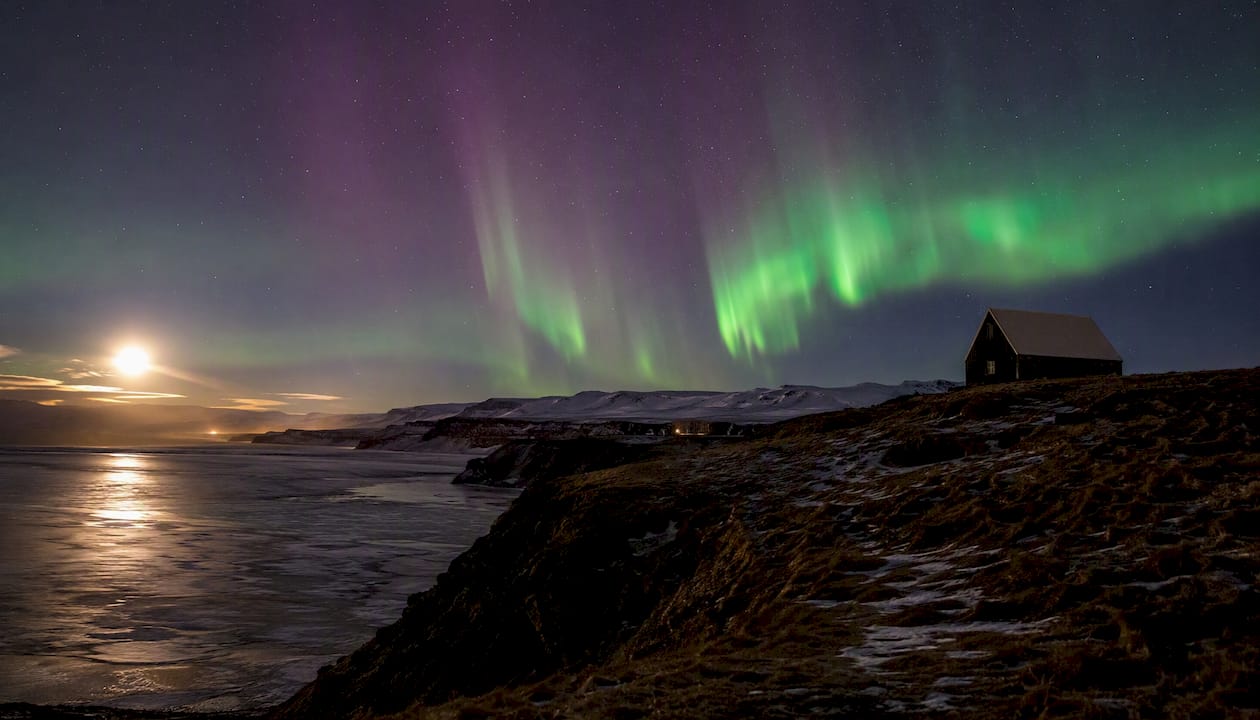
The aurora is what happens when charged particles from the sun slam into Earth’s upper atmosphere and excite the gases there into glowing. The northern version is the aurora borealis; the southern is the aurora australis. From Ireland, you can see them, but it takes a strong geomagnetic storm, a clear night, and a dark horizon — not something you can count on, but absolutely something that does happen.
Key Takeaways
The northern and southern lights are the same solar-driven phenomenon, split across hemispheres by Earth’s magnetic field, and Ireland can see them during strong geomagnetic storms.
| Point | Details |
|---|---|
| Same physical cause | Aurora borealis and aurora australis occur simultaneously during the same geomagnetic event. |
| Colors indicate altitude | Green comes from oxygen at 100–300 km; red from oxygen above 300 km; blue and violet from nitrogen. |
| Ireland visibility | Kp 5+ gives a real chance from dark northern locations like Donegal and Mayo. |
| Best forecasting combo | Use NOAA SWPC for Kp data, AuroraWatch UK for local alerts, and Met Éireann for cloud cover. |
| Photography basics | Wide aperture, ISO 1600–3200, 5–15 second shutter, manual focus, sturdy tripod. |
Table of Contents
- What are the northern lights and southern lights, exactly?
- How do auroras actually form?
- How do the aurora borealis and aurora australis compare?
- What colors and shapes can you expect to see?
- When and where are your best chances of seeing an aurora?
- Can you see the aurora from Ireland?
- How to read aurora forecasts and which services to trust
- Practical tips for viewing and photographing the aurora
- Technological impacts and traveler safety
- What research tells us about aurora mirroring and Ireland-scale events
- The aurora is worth chasing, wherever you are
- Sources
What are the northern lights and southern lights, exactly?
Both names come from Latin. Aurora was the Roman goddess of dawn; borealis means “of the north” and australis means “of the south.” The common names, northern lights and southern lights, describe the same physical event playing out in opposite hemispheres simultaneously.
A few terms worth knowing:
- Aurora borealis — the northern lights, visible from Arctic and sub-Arctic regions and occasionally at lower latitudes during strong storms
- Aurora australis — the southern lights, the mirror display occurring over Antarctica, southern South America, New Zealand, and Tasmania
- Auroral oval — the ring-shaped zone around each magnetic pole where aurora appears most reliably; it expands toward the equator during geomagnetic storms
- Geomagnetic storm — a disturbance in Earth’s magnetic field caused by solar activity, measured partly by the Kp index (a scale from 0 to 9)
- Kp index — the global measure of geomagnetic disturbance; higher numbers mean more activity and wider visibility
The two displays are not separate phenomena. They are one event, split across two hemispheres by the geometry of Earth’s magnetic field.
How do auroras actually form?
Electrons accelerated in Earth’s magnetosphere collide with atmospheric gases at roughly 80–500 km altitude, exciting atoms that emit light when they relax — producing the aurora. Think of it like a neon sign: electricity excites gas atoms, and they release that energy as colored light. The aurora works the same way, just at planetary scale.
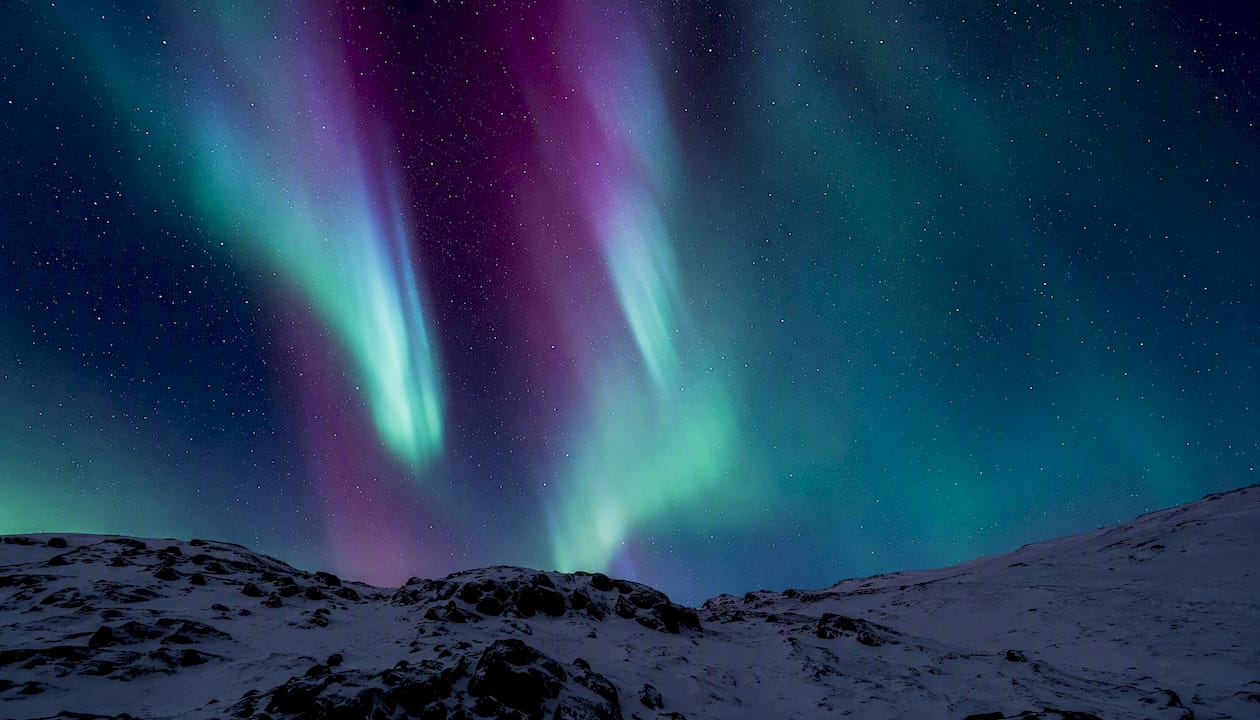
The process starts at the sun. The sun constantly streams charged particles outward as the solar wind. When that wind reaches Earth, most of it is deflected by the magnetosphere, the invisible magnetic bubble surrounding the planet. But near the magnetic poles, the field lines funnel particles downward into the upper atmosphere. There, electrons collide with oxygen and nitrogen atoms, knocking electrons into higher energy states. When those electrons drop back down, they release photons — light.
Solar storms such as coronal mass ejections can push charged plasma into Earth’s magnetosphere, increasing auroral activity and sometimes expanding visibility to lower latitudes. A strong CME can compress the magnetosphere on the sunward side and stretch it on the night side, triggering the rapid magnetic reconnection events that send bursts of particles cascading into the atmosphere. Auroral substorms can shift from a quiet arc to a horizon-filling curtain in seconds.
From the International Space Station, the aurora appears as continuous glowing ovals around each pole — structured, dynamic, and clearly organized by the magnetic field geometry below.
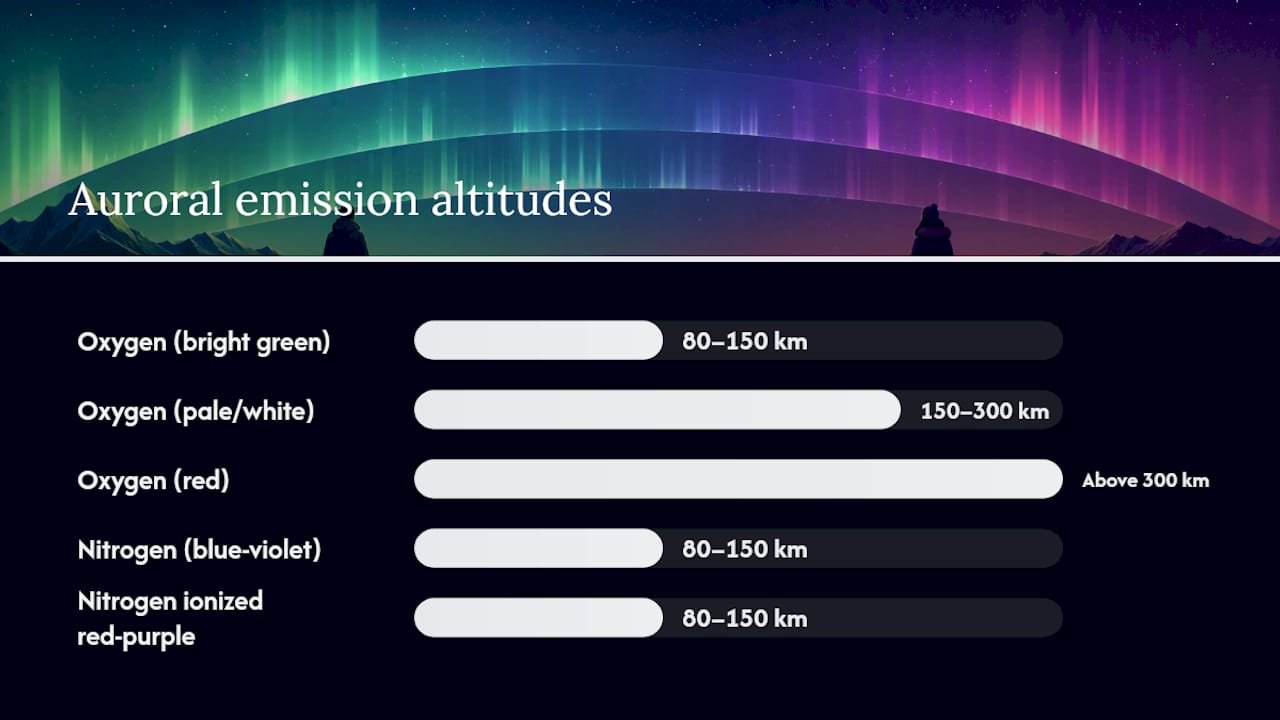
| Altitude (km) | Primary gas | Typical color |
|---|---|---|
| 80–150 | Oxygen | Bright green |
| 150–300 | Oxygen | Pale green to white |
| Above 300 | Oxygen | Red |
| 80–150 | Nitrogen | Blue to violet |
| 80–150 | Nitrogen (ionized) | Reddish-purple |
How do the aurora borealis and aurora australis compare?
The short answer: they are the same physical phenomenon. Auroral activity is directly correlated with geomagnetic activity; when the aurora is active in one hemisphere it will be active in the other at the same time. If a geomagnetic storm lights up Scandinavia, the same storm is producing an equivalent display over Antarctica at that exact moment.
The practical differences come down to geography, not physics:
- Accessibility — the Arctic sits within reach of populated continents (Europe, North America, Asia), while the Antarctic auroral oval lies mostly over open ocean and ice. Far more people can realistically travel to see the aurora borealis.
- Viewing infrastructure — Iceland, Norway, Finland, Canada, and Alaska have well-developed tourism around the northern lights. Southern lights tours exist but are concentrated in Tasmania, the southern tip of New Zealand’s South Island, and occasionally southern Argentina and Chile.
- Seasonal windows — both hemispheres need long, dark nights, so winter is prime time in each. That means September through March in the north, and March through September in the south.
- Auroral oval expansion — during strong geomagnetic storms, both ovals push equatorward. The northern oval can reach Ireland, Scotland, and even northern France; the southern oval can reach Tasmania and the southern tip of New Zealand.
- Symmetry — the two displays are mirror images. The same magnetic field geometry that creates arcs and curtains in the north creates the same shapes in the south, simultaneously.
For most travelers, the aurora borealis is the accessible choice. The aurora australis is equally spectacular but requires considerably more logistical effort.
What colors and shapes can you expect to see?
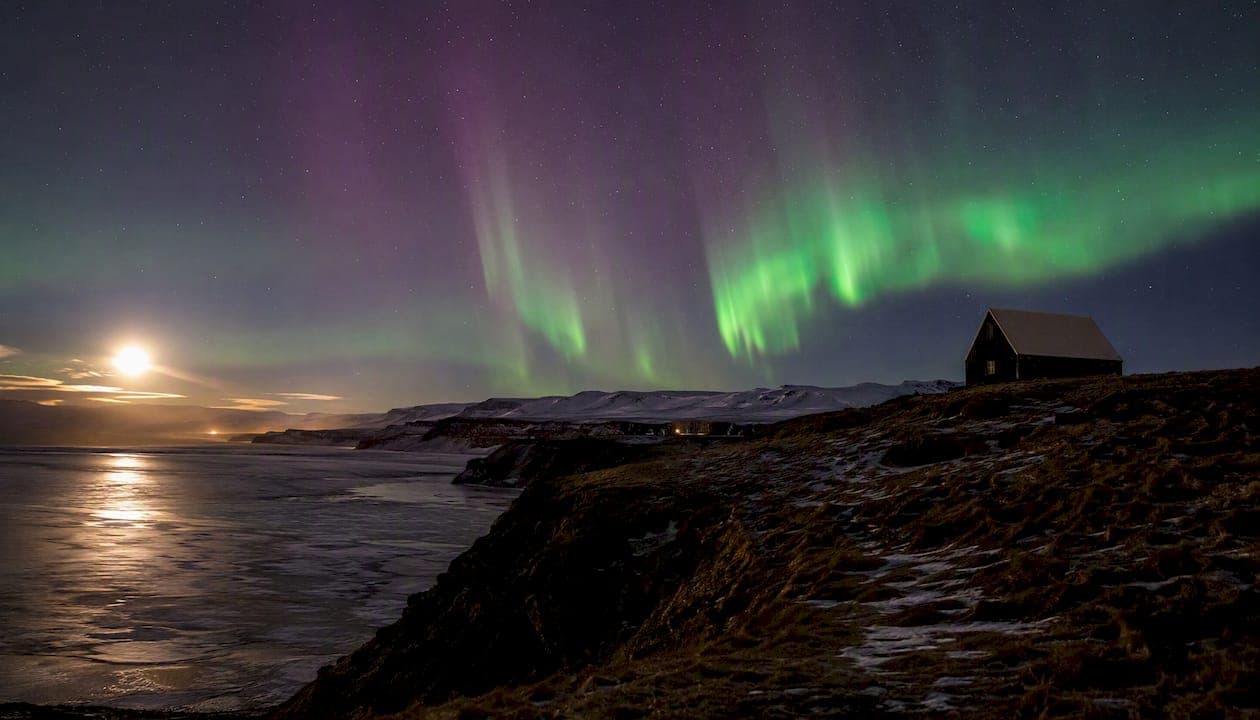
Oxygen and nitrogen emissions at different altitudes create the aurora’s colors: green and red from oxygen, blue and purple from nitrogen. Green is by far the most common color — it comes from oxygen at roughly 100–300 km altitude and is bright enough to photograph easily. Red aurora originates higher in the thermosphere, above about 300 km, and is often faint enough that cameras pick it up more clearly than the naked eye does. Blue and violet tones come from nitrogen and tend to appear at the lower edges of active displays.
Common aurora shapes, from quietest to most active:
- Diffuse glow — a faint, even luminescence low on the horizon; often the first sign of activity from lower latitudes like Ireland
- Arc — a smooth, curved band stretching across the sky; the classic quiet-night aurora
- Rays — vertical streaks extending upward from an arc, caused by particles following magnetic field lines
- Curtains — folded, rippling bands that look like fabric blowing in wind; these appear during moderate to strong activity
- Coronae — when you stand directly beneath an active display, rays appear to converge overhead in a radial pattern
- STEVE — a distinct phenomenon: a narrow, mauve or white ribbon of light running east-west, caused by a fast-moving stream of hot plasma in the sub-auroral zone rather than by the standard particle precipitation process; it is not technically an aurora but often appears alongside one
Pro Tip: Red aurora is frequently invisible to the naked eye but shows up clearly in long-exposure photos. If your camera captures red at the top of a display you couldn’t see with your eyes, that’s normal — your camera’s sensor is more sensitive to that wavelength than your eye is.
When and where are your best chances of seeing an aurora?
The best opportunities to see auroras are in winter months at high-latitude destinations; observers should favor dark, late-night windows and avoid artificial light pollution. In practical terms, that means planning around three variables: latitude, season, and geomagnetic activity.
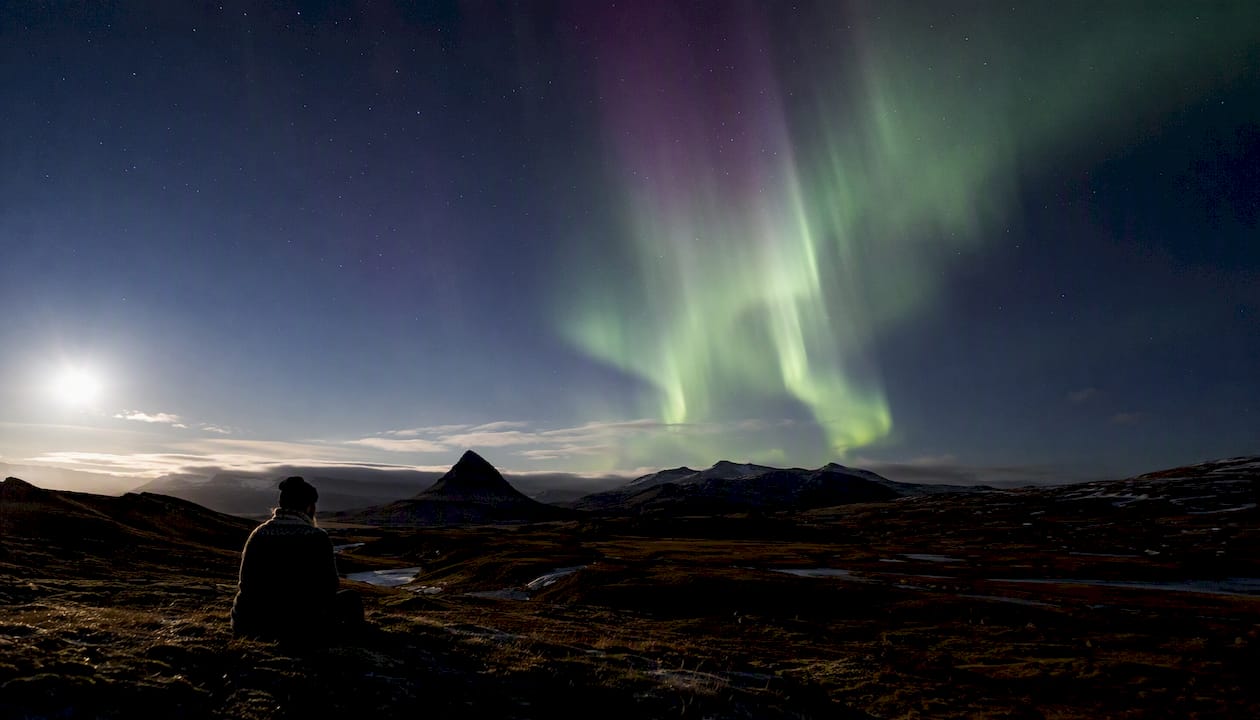
Northern hemisphere viewing locations:
| Region | Best months | Notes |
|---|---|---|
| Northern Norway (Tromsø) | October–March | Above the auroral oval; reliable activity |
| Iceland | September–April | Dark nights, low light pollution, accessible |
| Finnish Lapland | Late August–April | Long season; aurora cabins popular |
| Northern Canada (Yukon, NWT) | September–March | Remote but excellent dark skies |
| Alaska (Fairbanks) | September–March | Clear, cold nights; good infrastructure |
Southern hemisphere viewing locations:
| Region | Best months | Notes |
|---|---|---|
| Tasmania, Australia | March–September | Best mainland access to the southern oval |
| South Island, New Zealand | March–September | Otago and Southland have dark-sky reserves |
| Southern Patagonia | March–September | Remote; Cradle Mountain-style night spotting experiences exist in Tasmania |
| Antarctica | Year-round (winter) | Accessible only via expedition |
The nightly window runs roughly from 10 PM to 2 AM local time, peaking around local midnight. During major geomagnetic storms, the auroral oval expands equatorward, sometimes allowing aurora visibility at much lower latitudes such as parts of Spain and the southern United States.
Can you see the aurora from Ireland?
Yes, occasionally. Ireland sits at roughly 51–55°N latitude, which puts it well south of the auroral oval under normal conditions. But during strong geomagnetic storms, the oval expands, and Ireland falls within the visible zone. These events occur multiple times in years with high solar activity, and recent solar cycles have shown higher-than-anticipated activity levels.
What to look for and where:
- Donegal — the northwest coast offers some of Ireland’s darkest skies and a clear northern horizon over the Atlantic; Malin Head is a popular spot
- Mayo — Achill Island and the Mullet Peninsula have minimal light pollution and good elevation
- Kerry — the Iveragh Peninsula and areas around the Ring of Kerry offer dark skies, though the southern latitude makes sightings less frequent
- West Cork — the Mizen Head and Sheep’s Head peninsulas are worth trying during strong events
- Midlands and inland areas — generally too much light scatter from towns; coastal and elevated spots are far better
Realistic expectations matter. From Ireland, most aurora sightings are a faint greenish or whitish glow low on the northern horizon, not the dramatic curtains you see in Iceland or Norway. During an exceptional storm, full curtains and rays are possible, but that’s the exception. Cameras on long exposures will almost always capture more color and structure than the naked eye sees.
The best viewing season from Ireland typically corresponds to months with longer, darker nights, generally spanning the autumn and winter periods. Aim for nights around new moon to avoid lunar interference.
- Monitor Met Éireann for cloud cover forecasts — a clear night is non-negotiable
- Check AuroraWatch UK for real-time alerts calibrated to British Isles latitudes
- Watch the Kp index: Kp 5 gives Ireland a reasonable chance; Kp 7 or above makes sightings likely from most of the country
Pro Tip: Set up AuroraWatch UK alerts on your phone. The service sends notifications when geomagnetic activity reaches levels likely to produce aurora at UK and Irish latitudes — far more useful than checking manually.
How to read aurora forecasts and which services to trust
The core tools for aurora forecasting combine geomagnetic data with local weather. No single source gives you everything, so use them together.
Primary forecasting services:
- NOAA Space Weather Prediction Center (SWPC) — the gold standard for real-time geomagnetic data, Kp forecasts, and auroral oval maps. Their 30-minute and 3-day forecasts are the most widely used by serious aurora watchers. The SWPC also issues geomagnetic storm watches and warnings when CMEs are inbound.
- NASA — excellent for understanding the science and tracking solar events (flares, CMEs) that drive aurora activity; less focused on real-time operational forecasting than SWPC
- European Space Agency (ESA) — monitors solar activity from a European perspective; useful for longer-range solar event tracking
- AuroraWatch UK — run by Lancaster University; provides color-coded alerts specifically calibrated for UK and Irish latitudes; free email and app alerts
- Met Éireann — Ireland’s national meteorological service; essential for cloud cover forecasts, which are just as important as the Kp index
Understanding the Kp index for Ireland:
The Kp index runs from 0 (quiet) to 9 (extreme storm). For Ireland:
- Kp 4: possible faint glow from the far north of Ireland on a very dark, clear night
- Kp 5: reasonable chance from Donegal, Mayo, and other dark northern locations
- Kp 7+: visible from most of Ireland, including southern counties, with curtains and rays possible
Combine Kp with cloud cover and moon phase before heading out. A Kp 8 storm under full cloud cover is a wasted night. A Kp 5 with a clear, moonless sky from Malin Head is worth the trip.
Practical tips for viewing and photographing the aurora
Viewing basics:
- Get as far from artificial light as possible. Even a small town on the horizon can wash out a faint display.
- Let your eyes adapt to darkness for at least 20 minutes before judging what you can see.
- Dress for the conditions. Standing still in a field at 1 AM in January is genuinely cold; layer up with thermal base layers, a windproof outer shell, insulated boots, and gloves you can actually work a camera with.
- Check the forecast before you leave. Cloud cover is the single biggest obstacle.
- Be patient. Aurora can appear and disappear in minutes; staying out for two to three hours gives you a much better chance than a quick look.
Camera settings for aurora photography:
- Switch to manual mode — auto settings will not work in near-darkness.
- Set your aperture as wide as your lens allows (f/1.8 to f/2.8 is ideal; f/4 is workable).
- Start with ISO 1600–3200 and adjust based on the brightness of the display.
- Use a shutter speed of 5–15 seconds for a sharp, detailed aurora; longer exposures blur movement and lose structure.
- Focus manually on a distant star or bright light on the horizon — autofocus fails in the dark.
- Use a sturdy tripod and a remote shutter release or the camera’s self-timer to avoid camera shake.
- Shoot in RAW format if your camera supports it; it gives you far more latitude in post-processing.
For a detailed step-by-step walkthrough of aurora photography in Iceland, the Fox Hostel northern lights photography guide covers composition, white balance, and how to handle fast-moving displays.
Pro Tip: When the aurora is faint, push ISO higher and use a longer shutter speed. When it’s bright and moving fast, drop to ISO 800 and 3–5 seconds to preserve the structure — a 20-second exposure on a fast-moving curtain turns it into a smear.
Technological impacts and traveler safety
Auroras themselves are completely harmless to people. You can stand under one all night with no ill effects. The geomagnetic storms that produce them are a different matter for technology.
Potential technological impacts:
- Radio communications — high-frequency (HF) radio can experience blackouts during strong storms; this affects aviation and maritime communications
- GPS accuracy — ionospheric disturbances during storms can degrade GPS precision, sometimes significantly
- Compass anomalies — a strong geomagnetic storm can cause compass needles to deviate noticeably from magnetic north; relevant if you are navigating by compass in remote terrain
- Power grid stress — very large geomagnetic storms (Kp 8–9) can induce currents in long power transmission lines; major grid disruptions are rare but have occurred historically
For travelers chasing aurora in remote locations, the risks are practical rather than electromagnetic:
- Plan your route before dark and share it with someone who is not coming with you
- Check weather forecasts for wind, temperature, and precipitation — hypothermia is a real risk in exposed locations
- Carry a charged phone and a backup power bank; cold drains batteries fast
- Respect private land — many dark-sky spots in Ireland and Iceland are on private property; ask permission or use designated public access points
- Watch for coastal hazards — cliff edges and rocky shores are dangerous in the dark; stay on marked paths
What research tells us about aurora mirroring and Ireland-scale events
The hemispheric mirror effect is not a theory — it is a direct consequence of Earth’s magnetic field geometry. NOAA’s Space Weather Prediction Center confirms that auroral activity correlates directly with geomagnetic activity, and that when aurora is active in one hemisphere, it is active in the other simultaneously. The same solar wind pressure that drives electrons into the northern auroral oval drives them into the southern oval at the same moment.
For Ireland-scale forecasting, this matters because it means global space weather data is directly applicable. A CME that hits Earth will produce aurora in both hemispheres within the same event window. Monitoring SWPC data for the northern oval gives you an accurate picture of when conditions are right for Ireland, even though Ireland sits well south of the oval’s normal position.
Notable events that produced aurora visible from Ireland and the British Isles include a recent strong geomagnetic storm in 2024 produced widespread aurora sightings across Ireland, England, and in regions as far south as Spain. Events of that magnitude are rare but not unprecedented, and Solar Cycle 25’s elevated activity suggests more such events before the cycle peaks.
For Ireland-based planning, the practical takeaway is this: subscribe to SWPC alerts, watch AuroraWatch UK, and keep Met Éireann’s cloud forecast open. When all three align — high Kp, clear skies, and a dark-sky location — go.
The aurora is worth chasing, wherever you are
The science of the aurora is genuinely elegant. A star 150 million kilometers away fires a stream of charged particles into space, Earth’s invisible magnetic field catches them and funnels them toward the poles, and the atmosphere turns that energy into light. Green oxygen at 100 km, red oxygen at 300 km, blue nitrogen at the edges. The same event, mirrored perfectly across both hemispheres, every single time.
What I find underappreciated is how accessible this has become for Irish travelers. The May 2024 storm produced aurora photographs from Cork and Wexford. People saw it from suburban gardens. The tools to predict the next event are free, accurate, and available on your phone. The barrier is not knowledge or equipment — it’s cloud cover and the willingness to drive somewhere dark at midnight.
If you want to maximize your chances, Iceland is the obvious answer. The auroral oval passes directly over the country, dark skies are everywhere outside Reykjavík, and the season runs from September through April. Fox Hostel, set in Hrífunes Nature Park just east of Vík, sits in one of South Iceland’s darkest corridors. The barn conversion keeps you warm between checks; the location puts you under the oval. Check the best northern lights spots in Iceland to plan your viewing nights around the South Coast, or browse holidays built around aurora viewing if you want a full itinerary.
But even from Ireland, on the right night, with the right forecast and a dark field in Donegal, the aurora borealis is absolutely within reach.
Sources
These are the authoritative resources to bookmark for aurora science, real-time forecasting, and Ireland-specific alerts:
- Auroras — NASA Science
- Aurora — NOAA / NWS Space Weather Prediction Center
- Auroras: The Northern and Southern Lights | Center for Science Education (UCAR)
Combine at least two of these on any night you plan to go out: one for geomagnetic data (SWPC or AuroraWatch UK) and one for local weather (Met Éireann). Neither alone is enough.
Recommended
- Northern Lights Iceland Webcam Guide for 2026 | Fox Hostel – South Iceland
- Northern lights season : comprendre la magie islandaise | Fox Hostel – South Iceland
- Holidays to See Northern Lights: Best Trips to Book | Fox Hostel – South Iceland
- Photographing Northern Lights in Iceland: Step-by-Step | Fox Hostel – South Iceland