July Puffin Season in Iceland, What Travelers Need to Know
July Puffin Season in Iceland, What Travelers Need to Know

Iceland’s puffins arrive at their breeding cliffs from late April through May and stay until mid to late August, with June and July offering the most reliable viewing. Timing shifts a little each year depending on food supply and sea conditions, so travelers who build a few days of flexibility into their plans see the best results. The rest of this guide breaks the season down month by month and points you to the colonies worth the detour.
TL;DR:
- Puffins are most reliably visible from June to July when chicks hatch and adults are actively feeding, with peak activity during July.
- Large colonies like Heimaey and Látrabjarg offer the best chances for close-up viewing, but access and timing vary based on the site and season.
- Early mornings and late evenings provide the highest bird activity, especially during feeding flights with fish in their beaks.
- Visitor access to colonies like Dyrhólaey may be restricted during nesting season, so checking for closures beforehand is essential.
- Booking ferries, guided tours, and accommodations well in advance is crucial, especially during the busy June and July peak period.
Table of Contents
- Month-by-month puffin activity from April to September
- Where to find the best puffin colonies around Iceland
- When puffins are most active and how to watch them well
- Why puffin timing shifts from year to year
- What to check before you go: closures and viewing rules
- Planning the logistics: ferries, driving times, and booking windows
- A South Coast field note on catching the evening flight
- Staying near the puffin cliffs on the South Coast
- Sources
- FAQ
Month-by-month puffin activity from April to September
Puffin colonies do not switch on overnight. Each month brings a different scene, and knowing what to expect helps you time a trip instead of guessing.
April is a gamble. A handful of birds may show up at some colonies, testing the ledges before committing, but numbers stay low and sightings are inconsistent. It is not the month to build a puffin-focused itinerary around, though it works fine if you are passing through anyway and treat any sighting as a bonus.
May is when the season properly starts. Puffins return to their nesting cliffs in growing numbers, pairs reunite, and you will notice the bright orange and blue-gray breeding bills that make them so recognizable in photos. Courtship behavior picks up around the burrows. Reliability is medium: you will likely see puffins, but not yet in the dense, constant traffic of high summer.
June marks the shift into peak season. Eggs are incubating in the burrows and the first chicks, called pufflings, begin hatching toward the end of the month. Adults spend long stretches at the colony, which means steady flight activity and good, close photo opportunities on accessible cliffs.
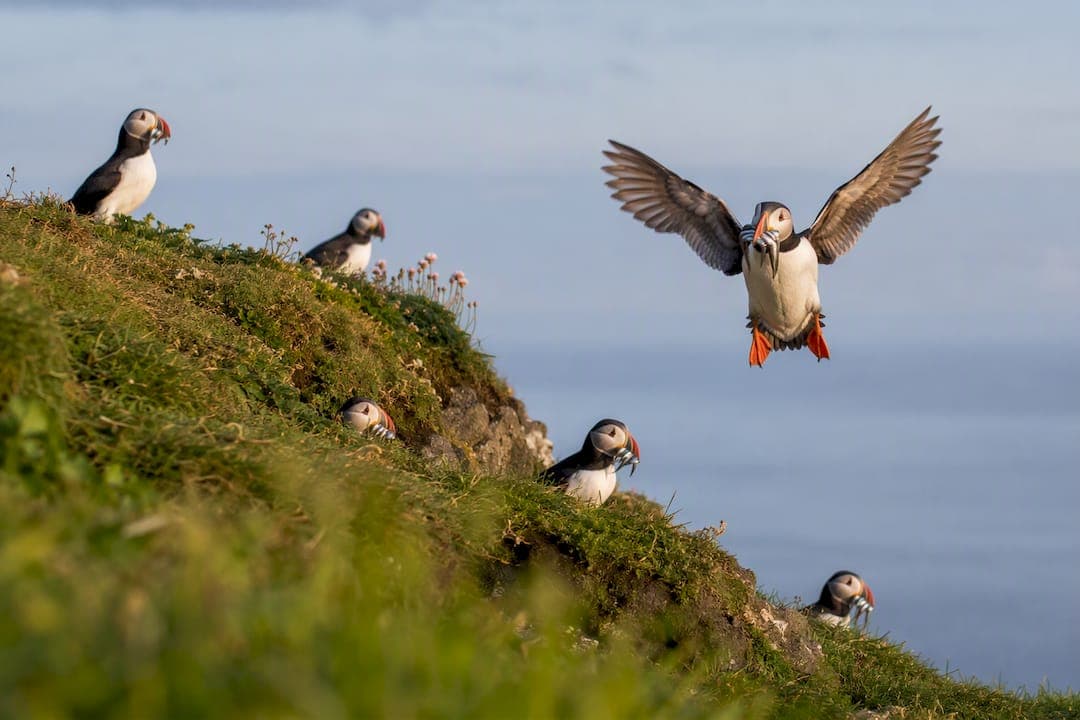
July is the single best month for puffin watching. Chicks are growing fast and need constant feeding, so adults make repeated fishing trips and return with beaks full of sand eels, creating the kind of nonstop flying, landing, and burrow visits that make a colony feel alive. If you can only pick one month, pick this one.
Early to mid August still offers decent viewing, but the energy starts to fade. Pufflings are nearly fledged, adults visit less often, and numbers at the cliffs begin to thin out.
By late August, most adult puffins have left for the open ocean, where they will spend the winter far from shore. Pufflings follow soon after, often fledging at night. Sightings from this point through September are rare and not something to plan a trip around.
- April: possible early arrivals, but numbers too low for a dedicated trip
- May: steady arrivals and courtship, medium viewing reliability
- June: incubation and early hatching, high reliability and strong photo conditions
- July: peak chick-rearing with constant fishing flights, the top month overall
- Early-mid August: activity declining as pufflings mature
- Late August onward: most birds gone to sea, sightings uncommon
Where to find the best puffin colonies around Iceland
Not every colony is equally easy to reach, and the right choice depends on how much time you have and how far you are willing to travel off the Ring Road.
Heimaey, the main island in the Westman Islands, hosts the largest Atlantic puffin colony in the country and remains one of the most dependable places to see them through the season, including its later weeks when other sites have quieted down. You reach it by a short car ferry from Landeyjahöfn on the South Coast, or by a quick domestic flight from Reykjavík. Because the colony is so large, it tends to hold visible activity even when numbers elsewhere are dropping off.
Dyrhólaey, near Reynisfjara on the South Coast, is one of the easiest colonies to fold into a Ring Road trip since it sits right off the main route. The catch is that this is a managed protected area, and the Environment Agency of Iceland can restrict access to parts of the promontory during nesting season to protect the birds. Always check current notices before you go, since a closure can change your plan on short notice.

Borgarfjörður Eystri, tucked into the East Fjords, offers something rarer: a purpose-built viewing platform at Hafnarhólmi that puts you within a few meters of active burrows without disturbing the birds. It is a detour from the Ring Road but a rewarding one, and the close, low-stress viewing setup makes it a favorite for photographers and families traveling with kids.
Látrabjarg, out in the Westfjords, holds some of the largest seabird cliffs in the North Atlantic and correspondingly massive puffin numbers. The tradeoff is distance: getting there usually means committing several extra days to the Westfjords loop, so it works best for travelers who already have that region on their route rather than as a quick add-on.
For those staying in or near Reykjavík with limited time, short boat tours out to Lundey or Akurey islands are the simplest option. These trips run in the summer months and often combine puffin viewing with whale watching, which makes them efficient if your schedule is tight, though the experience is more distant than a cliffside colony visit.
- Heimaey (Westman Islands): largest colony in Iceland, reached by ferry or flight, most reliable into late season
- Dyrhólaey: easy South Coast access but subject to seasonal closures
- Borgarfjörður Eystri: close, platform-based viewing, a worthwhile East Fjords detour
- Látrabjarg: enormous colonies in the Westfjords, best for travelers with extra days to spare
- Reykjavík boat tours (Lundey/Akurey): convenient, often paired with whale watching, less close-up than a cliff visit
Choosing between them comes down to your route and appetite for detours. If you are based on the South Coast, Dyrhólaey and Heimaey cover you well. If you have a Westfjords or East Fjords loop planned, Látrabjarg or Borgarfjörður Eystri are worth building the day around.
When puffins are most active and how to watch them well
Puffins are busiest at the colony during early morning and late evening, and Iceland’s long summer daylight means “late evening” can still offer strong light for photography and observation well past 9 PM in June and July. Midday visits tend to be quieter, with more birds resting on the water or inside burrows.
Watching for flight-with-fish behavior is one of the best ways to read a colony’s activity. Adults returning with a beak full of sand eels are heading straight for a burrow with a chick waiting inside, and a steady stream of these landings is a good sign you have hit a productive window. Burrow activity itself, birds pausing at entrances or ducking in and out, tends to pick up alongside this feeding rhythm.
A few habits protect both the birds and your visit. Stay on marked paths, since burrows are often just under the surface and can collapse under foot traffic. Keep a respectful distance rather than approaching for a closer shot, use a telephoto lens instead, and skip the flash, which can startle nesting birds. Cliff edges in Iceland are frequently unstable and unfenced, and combined with sudden gusts, they demand real caution, so never lean over for a better angle.
- Best times: early morning and late evening for peak activity
- Photography: telephoto lens, no flash, keep your distance
- Read the colony: frequent fish-carrying flights signal active feeding and healthy chick activity
- Safety: stay on paths, mind cliff edges and shifting winds
Pro Tip: Bring a lens with at least 300mm of reach. Puffins are small and skittish, and a longer lens lets you fill the frame without stepping past the marked viewing area.
Why puffin timing shifts from year to year

Puffin arrival dates and breeding success are not fixed on a calendar. They track closely with what is happening beneath the surface of the ocean.
Long-term monitoring research shows that puffin breeding timing and success are closely tied to the availability of age-0 fish, the young sand eels and similar prey that adults need in large quantities to feed chicks. In years when this prey is scarce or sea temperatures shift the timing of its availability, colonies can see reduced attendance, lower fledging success, and breeding schedules that move by weeks compared to a typical year. A separate look at phenology in the Westman Islands found that breeding has, in some cases, started noticeably later than it once did, and that productivity can swing sharply from one year to the next.
Breeding timing and success are closely linked to prey availability, and poor prey years can shift phenology by weeks while reducing colony attendance and fledging success.
For a traveler, this means a colony that was packed with activity last July is not guaranteed to look the same this year. It also means the reverse: a site that had a slow season previously can bounce back. The practical takeaway is to lean on the odds rather than a guarantee. June and July remain your best bet precisely because they sit in the middle of the reliable window regardless of these year-to-year swings, but it is worth having a backup plan, whether that is a second colony nearby or another activity, in case a particular site is unusually quiet when you arrive.
What to check before you go: closures and viewing rules
Protected sites like Dyrhólaey are actively managed to balance visitor access with nest protection, and that can mean seasonal restrictions on parts of the cliff or promontory during the height of incubation and chick-rearing. These closures, fenced viewing platforms, and rerouted trails are not bureaucratic hurdles. They exist because a single flushed nest can mean a lost clutch, and checking the Environment Agency of Iceland’s notices before you travel takes a few minutes and can save a wasted trip to a closed section.
A short list of habits keeps colonies healthy and keeps your visit on the right side of the rules:
- Stay on marked paths and boardwalks rather than cutting across open ground
- Never approach or reach into a burrow, even one that looks empty
- Keep noise down, since sudden sounds can flush nesting adults
- On boat tours, let the guide control approach distance rather than asking for a closer pass
If you come across a grounded or seemingly abandoned puffling, particularly in the Westman Islands during the late-summer fledging period, do not attempt to handle it yourself beyond moving it away from immediate road danger. Local rescue efforts run during this window specifically because young pufflings can become disoriented by lights and end up stranded in town, and volunteers are set up to take them in and release them safely.
Planning the logistics: ferries, driving times, and booking windows
A puffin trip built around June or July needs a bit of a head start, since that is also peak tourist season across the country.
- Book ferry crossings to Heimaey and any guided boat tours to Lundey or Akurey as early as you can once your dates are set, since summer sailings fill up and schedules can shift with weather.
- Map your driving times realistically: the South Coast sites cluster closely together, but a detour to Borgarfjörður Eystri in the east or Látrabjarg in the Westfjords adds a full day or more each way, so treat those as their own mini-trip rather than a quick stop.
- Lock in accommodation near your chosen colony well ahead of summer, since South Coast towns and Westfjords guesthouses both see high demand in June and July.
- Build in one flexible day if your schedule allows it, so a closure notice or a quiet colony does not derail the whole trip.
- Have a backup plan ready, whether that is a second puffin site within reach or another South Coast activity, in case sightings are lighter than expected on a given day.
Self-catering along the way is worth planning for too, especially if you are staying multiple nights near a colony. A little advance thought about meals and shared kitchens makes early starts easier, since you are not relying on a restaurant being open before a dawn puffin outing.
A South Coast field note on catching the evening flight
I have watched more than one group leave Vík at the last minute for an evening puffin run at Dyrhólaey, only to hit the return traffic from Reynisfjara and miss the best light. Staying closer to the colonies, rather than commuting from a town further out, buys you the flexibility to head out again if the first pass is quiet.
One habit that helps: pack a thermos and a snack before you leave for a late viewing session. Evening activity can run past 9 PM in summer, and you do not want to cut a good session short because everyone is hungry.
— Siggi
Staying near the puffin cliffs on the South Coast
A hostel located between Vík and Kirkjubæjarklaustur offers proximity to Dyrhólaey and the Reynisfjara area, allowing for early morning or late evening puffin viewing without a long drive.

Rooms are dorm-style throughout, and the booking setup offers flexible options for solo travelers, couples, families, and small groups. A communal kitchen is available for meal preparation, and an on-site pizzeria provides dining options without requiring plans around local restaurant hours.
- Book a bed in our shared dormitories or take over a full room for your group
- Traveling with a larger group heading out for puffin watching together? Check our group bookings options
- Pair your trip with a rafting adventure on a quieter day between colony visits
Check current availability and book your dates on the Fox Hostel rooms page.
Sources
- Atlantic Puffins in Iceland: Where & When to See Them
- Long-term monitoring study on puffin colony attendance and breeding success
- Dyrhólaey — access and management (Environment Agency of Iceland)
- Rent
- Borgarfjörður Eystri — puffin information
FAQ
Are puffins in Iceland yet in 2026?
Puffins typically return to Iceland’s breeding cliffs in late April or May each year, so by June they are well established at most colonies. Exact arrival can shift by a week or two depending on sea conditions and prey availability that season.
Do Icelanders still eat puffin?
Puffin has traditionally been eaten in parts of Iceland, particularly in the Westman Islands, though the practice has declined significantly and is far less common today than it once was. Visitors are more likely to encounter puffin on a menu as a novelty item than as a regular part of local diets.
Where can I see the most puffins in Iceland?
The Westman Islands, specifically Heimaey, host the largest Atlantic puffin colony in the country and stay reliable through much of the season. Látrabjarg in the Westfjords also holds enormous numbers, though it requires a longer detour to reach.
Can you walk to see the puffins in Iceland?
At several sites, including Dyrhólaey and Borgarfjörður Eystri’s Hafnarhólmi platform, you can walk to marked viewing areas and see puffins on foot without a boat. Other colonies, like those on Lundey or Akurey near Reykjavík, are only reachable by boat tour.