
What Is Sustainable Travel? A 2026 Practical Guide
What Is Sustainable Travel? A 2026 Practical Guide

TL;DR:
- Sustainable travel minimizes environmental harm, supports local economies, and respects host cultures. Most travelers now prioritize sustainability, mainly by reducing emissions and choosing local services. It requires continuous effort and high-impact choices like train travel and staying longer in fewer places.
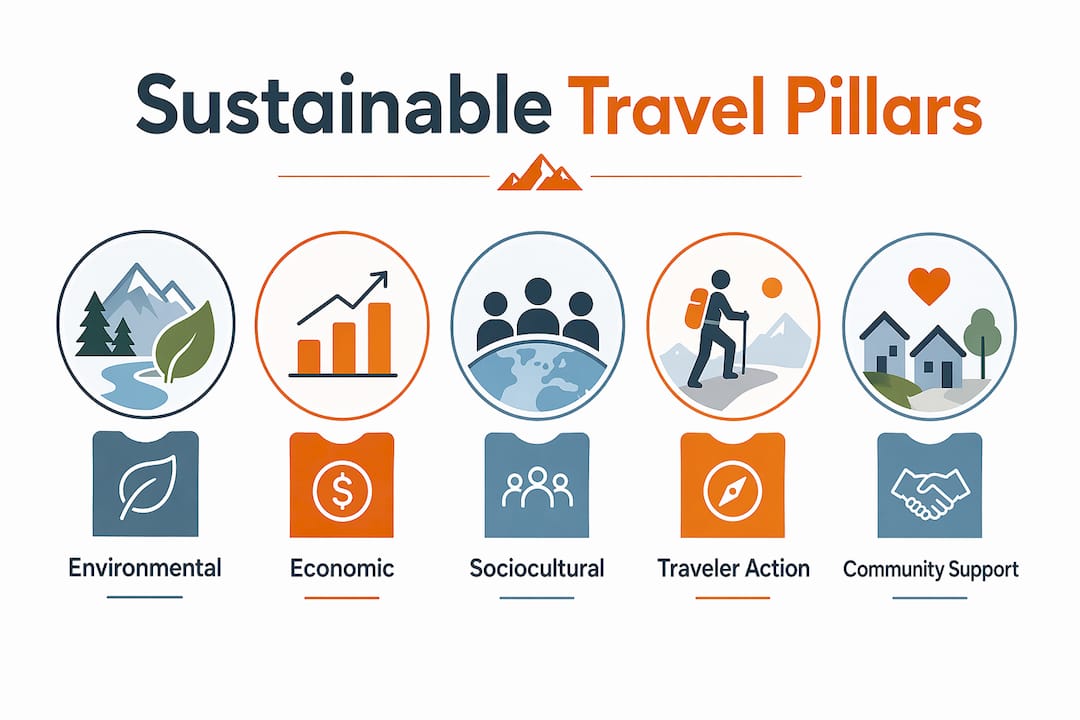
Sustainable travel is defined as exploring destinations in ways that minimize harm to the environment, support local economies, and respect the cultures of host communities to preserve those benefits for future generations. The formal industry term is sustainable tourism, a standard recognized by the United Nations World Tourism Organization and the Global Sustainable Tourism Council (GSTC). It rests on three pillars: environmental, economic, and sociocultural sustainability. Over 80% of travelers now consider sustainability important in their travel choices. That number signals a fundamental shift in how people plan and experience trips, not a passing trend.
What is sustainable travel and why does it matter?
Sustainable travel is the practice of making choices that reduce negative impacts across all three dimensions of tourism: environmental, economic, and sociocultural. Each pillar carries equal weight. Ignoring one while excelling at another produces incomplete results and can still harm a destination.

The environmental pillar addresses carbon emissions, ecosystem protection, and resource consumption. Tourism transportation accounts for roughly 72% of tourism’s total CO2 output, with aviation responsible for up to three-quarters of that transport share. That single statistic explains why flight choices carry more environmental weight than almost any other travel decision.
The economic pillar focuses on keeping money inside host communities. Sustainable tourism benefits local economies when spending stays within the community rather than leaking to offshore corporations. Eating at a family-run restaurant, booking a locally owned guesthouse, or hiring a community guide all keep revenue circulating where it creates the most good.
The sociocultural pillar protects cultural identity and community well-being. Tourism should preserve authentic culture and avoid displacing or exploiting local people. The displacement of the Maasai in East Africa to create wildlife tourism zones is a documented example of what happens when this pillar collapses. Sustainable travel demands that communities benefit from tourism, not suffer because of it.
| Pillar | Core Focus | Traveler Action |
|---|---|---|
| Environmental | Reduce emissions and protect ecosystems | Choose trains, avoid single-use plastics, stay in certified properties |
| Economic | Keep spending local, reduce financial leakage | Book independent hotels, eat local, hire community guides |
| Sociocultural | Preserve culture and community well-being | Respect local customs, avoid exploitative attractions |
Pro Tip: When evaluating a destination or tour operator, ask which of the three pillars their practices address. Any operator that only mentions “nature” while ignoring local wages is operating on one pillar, not three.
How to travel sustainably: practices that actually make a difference
Transport is the single highest-impact decision in any trip. Train travel emits 80–90% less CO2 per passenger than flying the same distance. Choosing the train from London to Edinburgh instead of flying eliminates roughly 90% of that leg’s emissions in a single booking decision.
Slow travel is the second most effective strategy. Slow travel reduces transit emissions more effectively than carbon offsets because it eliminates the emissions at the source rather than compensating for them afterward. Spending two weeks in one region instead of hopping across five countries cuts flight frequency, deepens cultural engagement, and puts more spending into fewer local economies.
Off-peak travel compounds these benefits. 42% of travelers now plan trips outside peak seasons specifically to reduce overtourism pressure and support local communities year-round. Visiting Iceland in february or november, for example, spreads economic benefit beyond the summer rush and reduces strain on fragile ecosystems.
Accommodation choices carry significant weight. Independent, locally owned hotels typically have 40–50% smaller carbon footprints than multinational chains, largely because of local supply chains and smaller operational scale. Look for properties with third-party certifications like Green Key or LEED, which verify environmental claims rather than relying on self-reported marketing. For a deeper look at what those certifications actually mean, the eco-friendly accommodation guide from Fox Hostel breaks down the key standards travelers should know.
Here are the top sustainable travel practices ranked by impact:
- Replace flights with trains or buses on routes under 600 miles.
- Stay longer in fewer places to reduce total transit emissions.
- Book independently owned, certified accommodations.
- Eat at locally owned restaurants using regional ingredients.
- Use public transit, cycling, or walking at your destination.
- Travel in the shoulder season to distribute economic benefit.
- Carry a reusable water bottle, bag, and utensils to cut single-use waste.
Pro Tip: Focus on the top two or three actions first. Switching one long-haul flight to a train saves more emissions than a year of reusable bags. Prioritize by impact, not by ease.
How does sustainable travel differ from ecotourism and regenerative tourism?
These three terms overlap but describe distinct approaches. Understanding the differences helps travelers choose experiences that match their values.
Sustainable tourism is the broadest category. It applies to all forms of travel, from city breaks to beach resorts, and aims to balance environmental, economic, and sociocultural impacts across the entire industry.
Ecotourism is a subset. It refers specifically to nature-based, low-impact travel that educates visitors about ecosystems while contributing to their conservation. A guided trek through a protected rainforest with a certified local operator qualifies. A resort built inside a national park boundary generally does not, regardless of how it markets itself.
Regenerative tourism goes further than either concept. Regenerative tourism actively restores and improves destinations rather than merely sustaining them. A traveler who volunteers for reef restoration, plants native trees, or funds a community school through their visit is practicing regenerative tourism. The goal shifts from “do less harm” to “leave it better than you found it.”
Responsible travel describes individual behavior. A traveler can practice responsible travel within any tourism category by following local rules, respecting wildlife, tipping fairly, and making informed choices.
Key distinctions at a glance:
- Sustainable tourism: system-level goal for the entire industry
- Ecotourism: nature-focused, conservation-linked experiences
- Regenerative tourism: active restoration of ecosystems and cultures
- Responsible travel: individual behavior choices within any travel type
Sustainable tourism is a goal, not a fixed achievement. Destinations must continuously reassess their carrying capacity and adjust tourism limits as conditions change. That dynamic quality is what makes it a practice rather than a certification you earn once.
What are the biggest pitfalls and misconceptions in sustainable travel?
Greenwashing is the most widespread problem in sustainable travel today. Greenwashing harms both environmental goals and consumer trust, and travelers increasingly demand transparent, verified proof of sustainability claims rather than vague marketing language. A hotel that places a “please reuse your towel” card in every room is not a sustainable property. That is a cost-saving measure dressed in green language.
Carbon offsets are widely misunderstood. Carbon offset programs frequently oversell their effectiveness. The correct sequence is: reduce emissions first, then offset only what cannot be avoided, and only through verified projects with independent auditing. Buying offsets without reducing emissions is not sustainable travel. It is accounting.
Vacation rentals present a nuanced case. Professional, locally owned hotels often manage energy and resources more efficiently than peer-to-peer rentals, which lack centralized systems for waste, energy, and water management. A private apartment rented through a platform may feel more “local,” but without management systems in place, its actual environmental performance is often worse than a certified hotel.
Travelers are increasingly informed and expect credible proof, not promises. Use these filters to evaluate any sustainability claim:
- Does the property hold a recognized third-party certification (Green Key, LEED, Rainforest Alliance)?
- Does the operator publish specific data on emissions, waste, or community contributions?
- Does the tour or experience employ and pay local people at fair wages?
- Is the “eco” claim specific and verifiable, or is it a general brand feeling?
Pro Tip: Ask your accommodation directly: “What percentage of your staff are local residents?” A genuinely community-rooted property will answer immediately. A greenwashing one will pivot to talking about solar panels.
How to plan a sustainable trip from start to finish
Planning a low-impact trip starts with the route. Map your destinations and identify the longest legs, since those carry the most emissions. Replace any flight under 600 miles with a train or bus where infrastructure allows. For ground transport at your destination, electric fleet transfers in Iceland offer a practical example of how low-emission options are expanding even in remote regions.
Select your accommodation before booking transport. Filter for properties with Green Key or LEED certification, or look for independently owned lodges and hostels with documented local supply chains. The role of accommodation location matters too: a property within walking distance of key sites eliminates the need for daily car rentals and reduces your total trip footprint.
Build your itinerary around local food and local guides. Eating at restaurants that source ingredients regionally keeps money in the community and reduces the supply chain emissions embedded in imported food. Hiring a local guide rather than a multinational tour operator keeps fees inside the destination economy and typically produces a richer experience.
Pack with intention. A carry-on-only approach reduces checked baggage weight, which lowers per-passenger fuel consumption on any flight you do take. Bring a reusable water bottle, a compact shopping bag, and a set of utensils. These items eliminate the most common sources of single-use plastic waste at any destination.
Key Takeaways
Sustainable travel requires reducing environmental impact, supporting local economies, and respecting host cultures simultaneously across every trip decision.
| Point | Details |
|---|---|
| Transport is the top priority | Train travel emits 80–90% less CO2 than flying the same distance. |
| Slow travel beats offsets | Staying longer in fewer places cuts emissions more effectively than purchasing carbon credits. |
| Local ownership matters | Independently owned properties carry 40–50% smaller carbon footprints than multinational chains. |
| Certifications beat self-reporting | Green Key and LEED certifications verify claims; vague “eco” labels do not. |
| All three pillars must align | Addressing only environment while ignoring local wages or culture produces incomplete sustainability. |
Sustainable travel is more urgent than it looks
By Siggi
The statistic that stops most travelers cold is the transport one. When you learn that aviation alone drives the majority of tourism’s carbon footprint, the conversation about reusable bags starts to feel like rearranging deck chairs. That is not cynicism. It is useful clarity.
What I have found after years of watching travelers engage with sustainability is that the ones who make the most impact are not the ones who do everything perfectly. They are the ones who make two or three high-leverage decisions and commit to them. They take the train. They stay in one place for a week instead of three days. They eat where the locals eat.
The terminology around this space has multiplied fast. Ecotourism, regenerative tourism, responsible travel, conscious travel. These distinctions matter, but they can also become a distraction. The underlying question is simpler: does your presence in a destination leave it better or worse than you found it? That question cuts through the marketing noise faster than any certification label.
Iceland is a useful case study. The country’s tourism infrastructure has grown faster than its carrying capacity in some areas, and the tension between access and preservation is real. Travelers who choose rural stays, travel in the shoulder season, and use local transport make a measurable difference to how that pressure distributes across the country.
Sustainable travel is not a perfect standard. It is a continuous process of improvement, not a badge you earn once. The travelers who understand that tend to make better decisions at every step.
— Siggi
Sustainable travel starts with where you sleep in Iceland
Choosing where to stay is one of the most direct ways to put sustainable tourism principles into practice. Fox Hostel sits inside Hrífunes Nature Park, 35 minutes east of Vík, in a converted traditional Icelandic barn that keeps its footprint small and its connection to the land genuine. The hostel supports the local South Iceland economy, operates away from the overcrowded tourist corridors, and gives travelers a base for exploring Reynisfjara Black Sand Beach, Vatnajökull National Park, and Jökulsárlón Glacier Lagoon without adding to the congestion around Reykjavík.

Solo travelers can book a single bed. Groups can buy out an entire dorm for privacy. The communal kitchen, on-site pizzeria, and Northern Lights-ready dark skies make Fox Hostel a place where sustainable travel choices and genuine comfort reinforce each other. Book your stay and put your sustainable travel values into practice on Iceland’s South Coast.
FAQ
What is the simplest definition of sustainable travel?
Sustainable travel is the practice of visiting destinations in ways that minimize environmental harm, support local economies, and respect host cultures to preserve those benefits for future generations.
Is ecotourism the same as sustainable travel?
Ecotourism is a subset of sustainable travel focused specifically on nature-based, low-impact experiences that contribute to conservation. Sustainable travel applies to all trip types, not only nature destinations.
Do carbon offsets make travel sustainable?
Carbon offsets alone do not make travel sustainable. Travelers should reduce emissions first by choosing trains over flights and practicing slow travel, then offset only unavoidable emissions through verified, independently audited projects.
How do I spot greenwashing in travel?
Look for third-party certifications like Green Key or LEED rather than self-reported claims. Ask operators for specific data on local employment, waste management, and energy use. Vague “eco-friendly” labels without verification are a reliable warning sign.
What is regenerative tourism?
Regenerative tourism goes beyond sustainability by actively restoring ecosystems and strengthening local cultures, rather than simply reducing harm. Examples include reef restoration programs, reforestation projects, and community-funded education initiatives tied to tourism revenue.
Recommended
- What Is Communal Lodging? A Traveler’s 2026 Guide | Fox Hostel – South Iceland
- The Role of Shared Spaces in Travel: 2026 Guide | Fox Hostel – South Iceland
- Practical Travel Amenities: What Every Traveler Needs | Fox Hostel – South Iceland
- What Is Eco-Friendly Accommodation: A Traveler’s Guide | Fox Hostel – South Iceland