Avoid Voiding Rental Insurance on Iceland's F-Roads
Avoid Voiding Rental Insurance on Iceland’s F-Roads
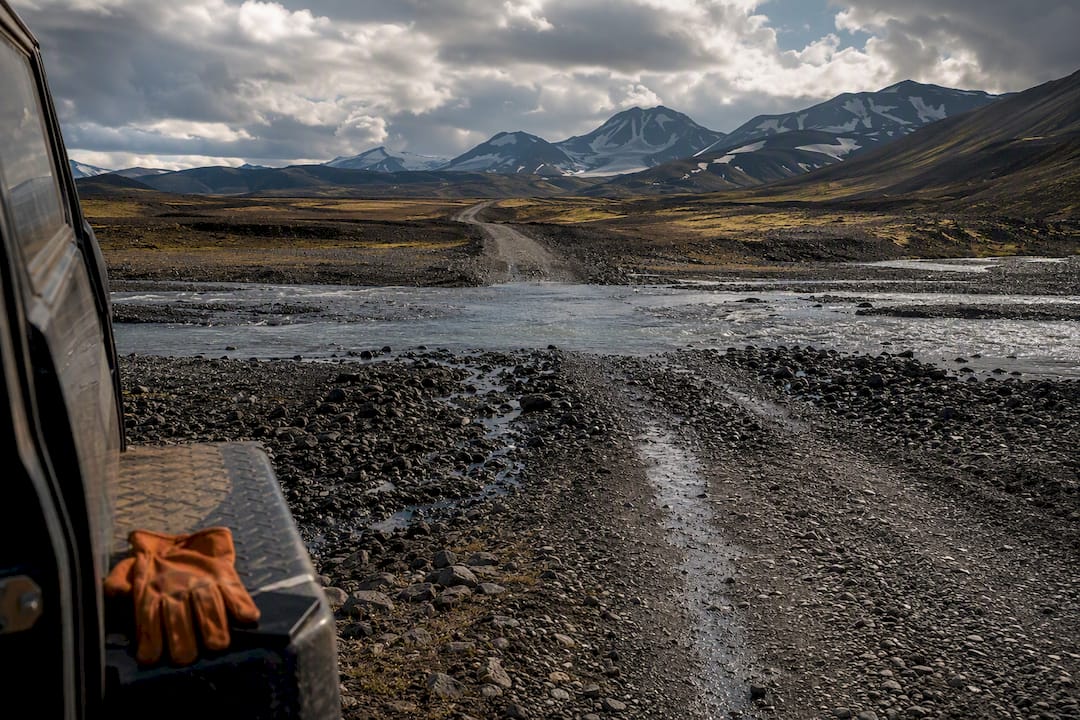
F-roads are Iceland’s mountain roads, legally separate from the rest of the highway network, and driving one demands a 4WD vehicle by law. Most open only from mid-June through September, close by law to 2WD traffic (which also voids rental insurance), and change status day by day. Before you plan a route, check Road the morning you intend to drive, since that is the only live authority on what’s actually open.
TL;DR:
- Only high-clearance, all-wheel-drive vehicles are legally permitted on F-roads, and driving a 2WD or non-approved vehicle risks fines and insurance voidance.
- F-road conditions can shift rapidly due to weather, snowmelt, and river flow, making live checks on road.is and weather forecasts essential before each drive.
- F-road routes vary widely in difficulty; well-maintained routes like F35 are accessible to mid-size 4x4s, but long crossings like F26 require capable, heavy-duty vehicles.
- Unbridged river crossings are the primary hazard, with safety depends on current water depth, flow, and careful pre-crossing assessments, especially early in the morning.
- Proper preparation involves full fuel tanks, extra supplies, a full-size spare, satellite communication, and filing a travel plan with SafeTravel to aid rescue efforts if needed.
Table of Contents
- What Are F-Roads in Iceland, Legally and Physically?
- When Do F-Roads Open, and How Do You Check Live Status?
- What Vehicle Do You Actually Need for F-Roads?
- How Do You Cross a River on an F-Road Safely?
- What Should You Pack Before Driving an F-Road?
- Which F-Roads Should You Actually Drive?
- Should You Self-Drive or Book a Guided Highland Tour?
- How Does a South Coast Base Help With F-Road Planning?
- What Environmental Rules Apply on F-Roads?
- Why Following the Rules Matters More Than It Seems
- A South Coast Base for Your Highland Days
- Where to Check Before You Drive
- Sources
What Are F-Roads in Iceland, Legally and Physically?
An F-road, or fjallvegur (mountain road), is any route in Iceland’s interior marked with an “F” before its route number: F35, F208, F26, and dozens more. That single letter carries legal weight. Icelandic traffic regulation restricts these roads to four-wheel-drive vehicles, and driving one in a 2WD is a punishable offense that also voids rental insurance the moment something goes wrong. This is not a suggestion aimed at cautious tourists. It’s a rule enforced through both traffic law and the fine print of every rental contract in the country.
The signage matches the seriousness, as explained in the Iceland ring road: your complete self-drive guide. F-roads carry yellow route markers instead of the green ones used on paved and regular gravel roads, and you’ll often see a posted warning at the entrance stating the vehicle requirement outright. Once you’re past that sign, you’re on your own in a way that rarely happens elsewhere in Iceland.
Surface and infrastructure look nothing like the Ring Road:
- Loose gravel, volcanic ash, lava rock, and washboard sections that shift after every heavy rain or thaw
- Unbridged river crossings, sometimes several on a single route
- No fuel stations, no cafes, no farms, and often no other vehicles for hours at a time
- Patchy to nonexistent mobile signal across most of the interior
- No winter maintenance or plowing, which is part of why the roads close entirely for months
The distinction that trips people up: not every gravel road in Iceland is an F-road, and not every F-road is equally hard. A stretch of ordinary secondary gravel road (no F prefix) can be rough, but it’s still built to standard highway specifications and typically passable in a well-driven 2WD. An F-road, by contrast, was built with the assumption that only high-clearance, all-wheel-drive vehicles would ever use it. The prefix is the legal signal that separates “gravel road” from “highland road,” and treating the two as interchangeable is where a lot of rental-insurance disputes start.
When Do F-Roads Open, and How Do You Check Live Status?
There’s no fixed calendar for F-road openings. Most highland routes open somewhere between mid-June and mid-July and close again by September or early October, but Vegagerðin, the Icelandic Road and Coastal Administration, assesses each route individually based on snowmelt, ground stability, and river conditions rather than a set date. A dry spring can open F35 two weeks early. A wet, cold one can leave F26 closed into July.
road.is is the tool that matters here. The site’s interactive map uses color codes for every numbered road in the country, including every F-road, updated as conditions change:
- Green typically means open with normal caution
- Yellow or orange flags difficult conditions, often river crossings or fresh gravel
- Red means closed, and driving a closed F-road can carry fines on top of any insurance exposure
- A closed road with no F-road markings shown at all usually means it hasn’t opened for the season yet
Pro Tip: Check road.is the same morning you’re driving, not the night before. Highland conditions can shift with a single overnight rain event, and a route that showed green at 8 p.m. can flood a ford by sunrise.
Weather is the other half of the equation. The Icelandic Met Office (Veðurstofa Íslands) publishes highland-specific forecasts that matter far more up there than the coastal forecast you’d check for Reykjavík or Vík. Wind gusts that are a minor inconvenience on the Ring Road can be genuinely dangerous on an exposed F-road ridge, and SafeTravel Iceland’s guidance is explicit that the highland environment can turn volatile with little warning, even in the middle of summer.
What Vehicle Do You Actually Need for F-Roads?
Every rental agreement in Iceland treats “4WD” as the baseline, but not all 4WDs are built the same, and F-roads punish that difference. A small crossover with all-wheel drive and 6 inches of clearance is a different machine than a lifted Land Cruiser with reinforced underbody protection, even though both might get called “4x4” on a rental site.
Three practical categories cover most rental fleets:
- Compact 4x4 (Dacia Duster, Suzuki Vitara class): fine for graded, well-maintained routes like F35 in dry conditions, underpowered for anything with a serious ford
- Mid-size 4x4 (Toyota RAV4, Hyundai Santa Fe class): handles most moderately difficult F-roads and shallow crossings with confidence
- Heavy-duty / superjeep (Toyota Land Cruiser or Hilux with lift kits, 35 inch tires): built for Sprengisandur, Askja approaches, and anything with a deep or fast-moving river crossing
Rental insurance policies reflect this hierarchy directly. Standard collision coverage on a rental car almost never covers highland driving at all, and even a properly rated 4WD usually needs a separate highland protection add-on, sometimes called gravel and sand ash protection (SAAP) bundled with F-road coverage, before you’re actually covered for the routes you’re planning. Skip that add-on and hit a rock hard enough to puncture the undercarriage, and you’re paying full repair cost yourself.
There’s also a rule that surprises a lot of first-time renters: many companies explicitly ban specific F-roads for specific vehicles in the rental contract, regardless of what the insurance covers. F249 to Þórsmörk is the classic example, forbidden for most fleets outright because of its river crossings, even for capable 4WDs.
Confirm all of this at the pickup counter, not after you’re on the road:
- Which specific F-roads (by number) your contract permits and which it excludes
- Whether highland/gravel protection is included or needs adding
- Ground clearance and whether the vehicle has a locking differential or just electronic traction control
- Spare tire type (full-size versus a space-saver) and whether a tire repair kit is included
If you plan to reach Sprengisandur, Askja, or Þórsmörk, book the heavier vehicle from the start. A performance gap this wide between rental categories means the “cheap 4WD upgrade” often isn’t actually rated for the route you booked it for.
How Do You Cross a River on an F-Road Safely?
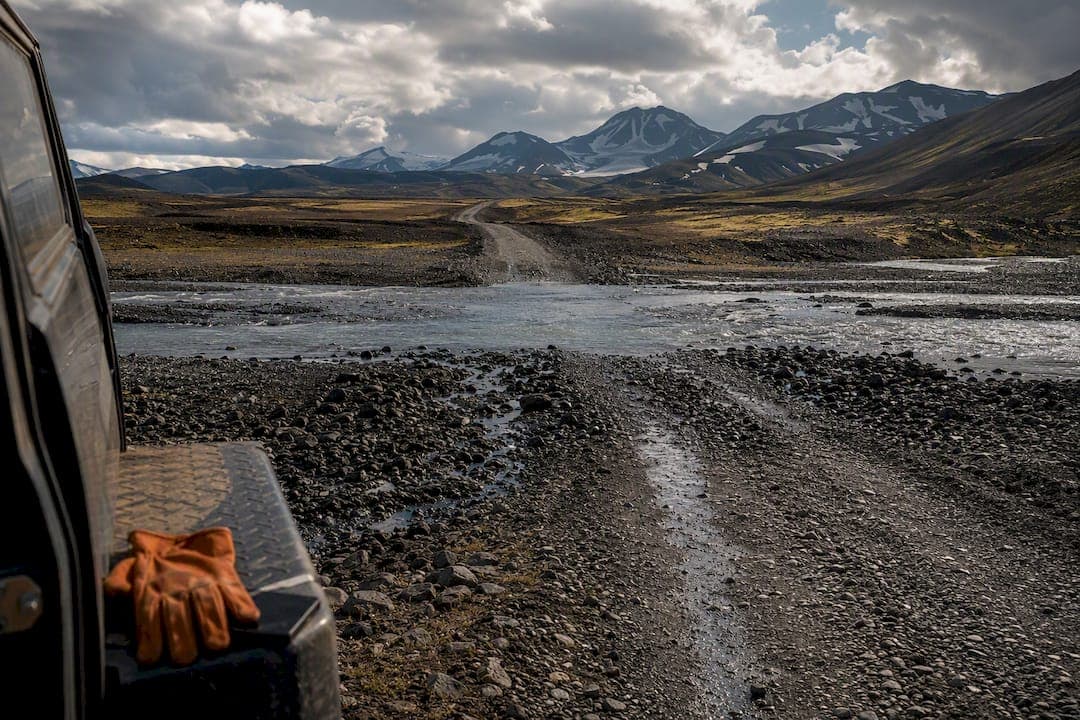
Unbridged river fords, not the gravel surface, cause most F-road trouble. Icelandic highland rivers are fed by glaciers, which means depth and flow can change dramatically within the same day. A crossing that’s knee-deep at 8 a.m. can be a meter deep by 4 p.m. once the day’s melt reaches the valley.
Field guidance from experienced highland drivers uses rough depth thresholds for judging whether to attempt a crossing: roughly 40 centimeters (about 16 inches) as the practical limit for most small 4x4s, 60 centimeters (about 22 inches) for larger, higher-clearance vehicles, and 80 centimeters (about 32 inches) as a hard no for essentially any rental vehicle. Those numbers assume calm, clear water. Fast-moving or cloudy glacial water is more dangerous at any given depth than a slow, clear stream, because you can’t judge the riverbed and the current itself can push a vehicle sideways.
Follow this sequence before committing to any ford:
- Get out and walk it first, if it’s safe to do so, using a stick or trekking pole to check depth and feel for a stable bottom.
- Watch how other 4WDs cross if any are around. If a similar vehicle to yours struggles, don’t follow.
- Pick the widest point of the river rather than the narrowest. Wide usually means shallower and slower.
- Enter in low range at walking speed, cross at a slight upstream angle, and keep steady, continuous momentum. Never stop mid-river.
- If the engine stalls in the water, do not restart it. Get everyone out safely and call for a tow rather than risk water in the engine.
- When in doubt, turn back. There is no F-road destination worth a stalled or swept vehicle mid-river.
Morning crossings tend to be safer than afternoon ones simply because glacial melt hasn’t built up yet, which is one more reason to start highland days early. The convoy rule matters too: never be the only vehicle attempting a crossing on a route known for difficult fords, and never cross alone if you can wait for a second car to travel with.
What Should You Pack Before Driving an F-Road?
Preparation on an F-road is less about gear you might use and more about the gap between “inconvenient” and “genuinely stranded” that a missing item can create once you’re two hours from the nearest paved road.
Fuel and supplies:
- Fill the tank completely before leaving the Ring Road; there are no gas stations on F-roads themselves
- Carry more food and water than you think you’ll need; a delayed crossing or closed road can add hours to a plan
- Pack warm layers regardless of the season. Highland temperatures drop fast, especially at elevation on routes like Sprengisandur
Vehicle and tools:
- Confirm you have a full-size spare, not a space-saver, plus a tire repair kit and a basic tool set
- Bring a tow strap; even careful drivers occasionally need a pull out of soft gravel or mud
Comms and navigation:
- Download the SafeTravel 112 Iceland app and file a travel plan before you leave, so search and rescue knows your route if you don’t check in
- A satellite messenger device is worth the rental cost on remote routes like F26 or F88, where mobile signal disappears entirely
- Download offline maps in advance, since you cannot rely on data once you leave populated areas, and carry a printed map as backup
Pro Tip: Filing a route plan with SafeTravel takes about two minutes and costs nothing. It’s the single easiest thing you can do to shorten a rescue response time if something actually goes wrong.
Which F-Roads Should You Actually Drive?
Not every highland route demands the same nerve or the same vehicle. Route difficulty varies enormously across the F-road network, and matching your experience to the right road matters more than horsepower.
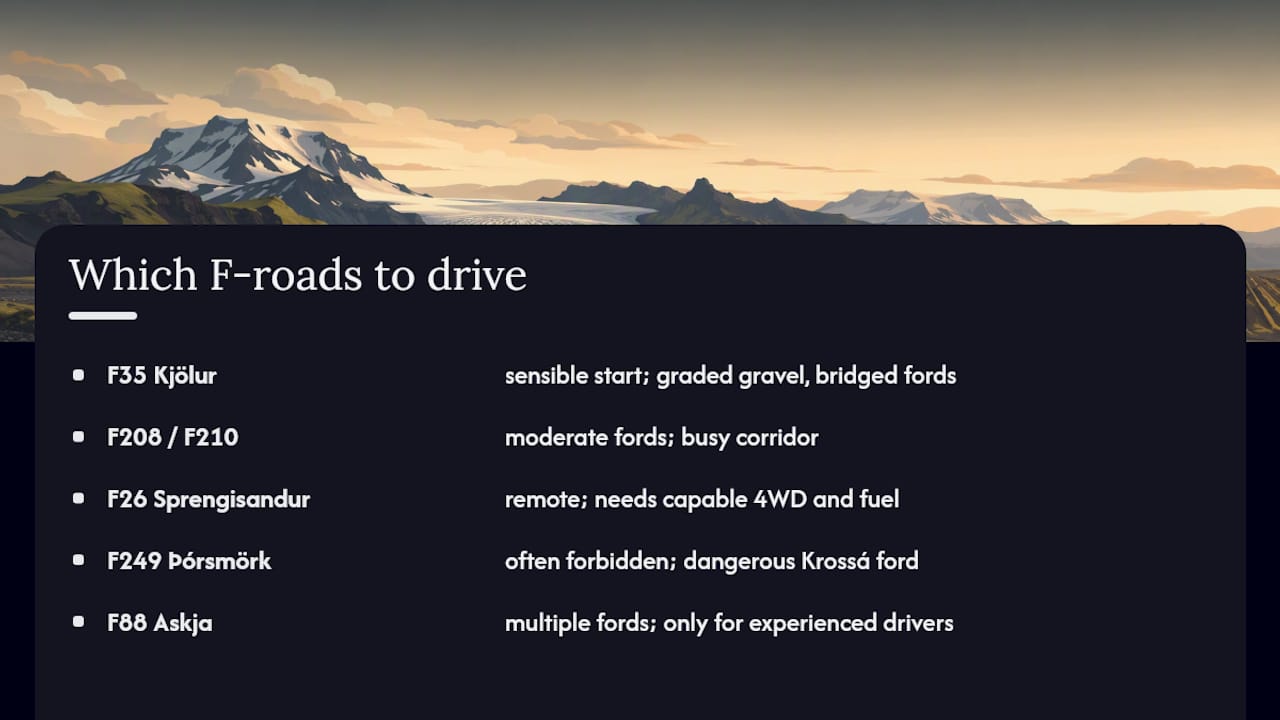
F35, Kjölur, is the sensible starting point for a first highland drive. It crosses the interior between the Langjökull and Hofsjökull glaciers on a route that’s largely graded gravel with bridged river crossings, meaning the main hazard of an unbridged ford is mostly removed. A mid-size 4x4 handles it comfortably in dry summer conditions.
F208 and F210 lead into Landmannalaugar, one of the most visited highland destinations in the country, known for its rhyolite mountains and geothermal bathing river. Expect a handful of moderate fords rather than deep technical ones, but expect company too. This is the busiest highland corridor in Iceland during peak season.
F26, Sprengisandur, is the long haul across the empty center of the island. There’s no fuel, no services, and long stretches with zero other traffic, so this route calls for a properly capable 4WD and a fuel plan that accounts for the full distance with margin to spare.
F249 to Þórsmörk is the one most rental contracts specifically forbid, thanks to the Krossá river, a wide, fast, and unpredictable glacial crossing that has stranded and damaged more rental vehicles than almost any other single spot in the country. Most visitors reach Þórsmörk by specialized highland bus instead of self-driving, and that’s the right call for the vast majority of travelers.
F88 to Askja pushes further, crossing multiple fords en route to one of Iceland’s most striking volcanic calderas. This is a route for experienced highland drivers in heavy-duty vehicles, not a first attempt at F-road travel.
Should You Self-Drive or Book a Guided Highland Tour?
The honest answer depends on which route you’re chasing, not on how confident you feel behind the wheel. F35 and a dry-season F208 are realistic for a capable, careful self-driver. F249 and F26 are a different calculation entirely.
Self-driving means paying for the vehicle, the insurance add-ons, and your own time and attention, in exchange for total schedule flexibility. Highland-capable rental rates run meaningfully higher than standard Ring Road rentals, and once you factor in the highland protection add-on, the total cost gap versus a standard car narrows the case for going it alone unless you’re already planning multiple highland days.
Guided super-jeep tours and highland buses hand the hardest decisions to someone who makes them every week of the summer. A guide who crosses the Krossá three times a week reads the river in a way a first-time visitor simply cannot, and that judgment is exactly what keeps a trip to Þórsmörk or Askja from becoming a rescue story.
Guided transport is the responsible choice on three routes in particular:
- F249 to Þórsmörk, where the Krossá crossing sinks unprepared vehicles most seasons
- F88 to Askja, given the distance, multiple fords, and total lack of services
- F26 Sprengisandur if you don’t have real highland driving experience, given the sheer remoteness
If your itinerary is built around one or two accessible routes like F35, self-driving is a genuinely good option. If it includes Þórsmörk or Askja, book the bus or the super-jeep and put the money toward the experience instead of the risk.
How Does a South Coast Base Help With F-Road Planning?
Staying near Vík puts you within easy striking distance of several southern F-road approaches, which matters more than it sounds. A lot of highland day trips run long, and starting from a base 35 minutes east of Vík rather than driving out from Reykjavík that same morning buys you real hours in the highlands before the light or the weather turns.
Fox Hostel sits in Hrífunes Nature Park, positioned between Vík and Kirkjubæjarklaustur, which works well as a launch point for southern highland routes and for the longer push east toward Vatnajökull National Park and Jökulsárlón the following day. A few practical things matter when you’re staging an early highland departure:
- A full communal kitchen means you can cook a real breakfast and pack food for the day before an early start, rather than relying on limited options along the way
- Flexible booking (individual beds for solo travelers, full-room buyouts for couples, families, or groups) means a small highland-bound group can lock down privacy without paying for a hotel
- Dark, rural skies make for genuinely good Northern Lights viewing on the nights you’re not out driving
If you’re mapping out how F-road days fit into a longer South Coast stay, a South Coast itinerary guide is worth reading alongside route planning, since timing your highland day against your other South Coast stops (Reynisfjara, Dyrhólaey, Skógafoss) usually works better than trying to do everything in one exhausting loop.
What Environmental Rules Apply on F-Roads?
Off-road driving, meaning leaving the marked track for any reason, is flatly illegal in Iceland, not just discouraged. The law exists because highland vegetation, particularly moss, recovers extremely slowly from tire damage, sometimes taking decades to fill back in a set of ruts left by a single vehicle in a single afternoon.
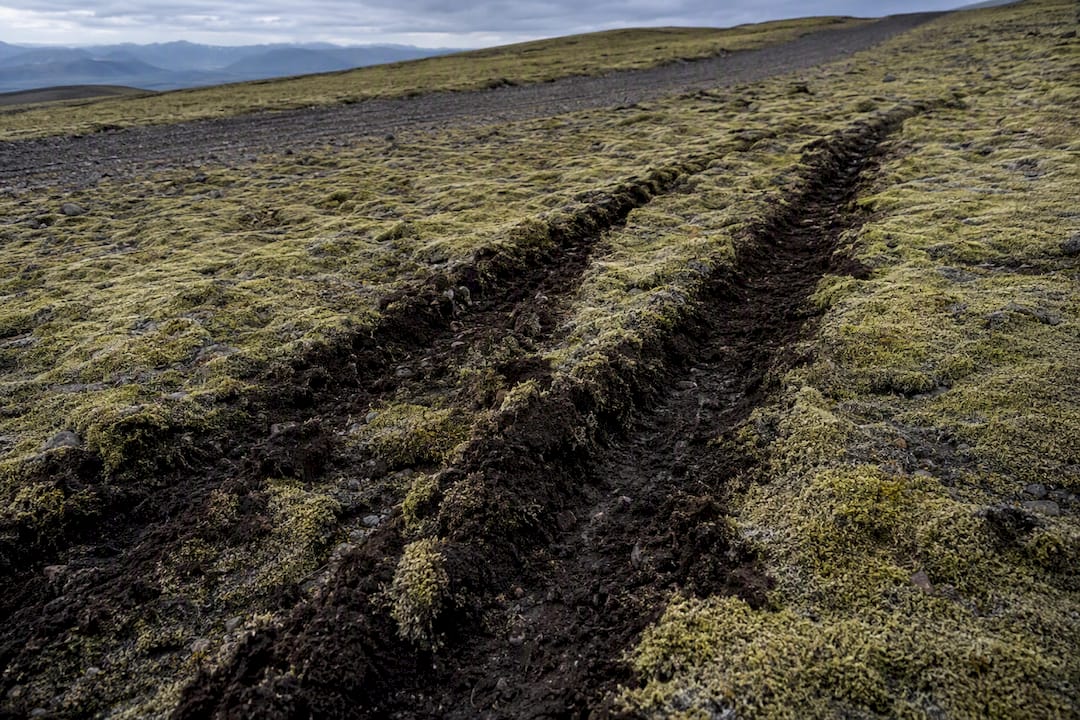
Enforcement is real, not theoretical. Fines for off-track driving in Iceland can run into the thousands of dollars, and rental companies routinely bill separately for any damage that suggests off-road use, since it voids coverage the same way a 2WD on an F-road does.
Stay on the marked track even when it looks flooded, muddy, or blocked by another vehicle. Widening a ford by driving around a stuck car, or cutting a new line around a soft patch, is exactly the kind of decision that turns a temporary mud patch into permanent scarring on land that has almost no capacity to heal itself quickly. If a route looks genuinely impassable, the correct move is to turn back, not to improvise a new path around it.
The same logic extends to camping and parking. Stick to designated areas and existing pull-offs rather than driving onto open ground to park closer to a view. Iceland’s highland ecosystem is visually tough but structurally fragile, and the rules exist because that fragility is the whole reason people drive out there to see it in the first place.
Why Following the Rules Matters More Than It Seems
People treat F-road regulations as bureaucratic caution, and that’s a mistake I’d push back on directly. A single set of tire tracks off the marked track can outlast the person who made them; Icelandic moss recovers so slowly that damage from decades ago is still visible in the highlands today. This isn’t a landscape that forgives improvisation.
The rules also protect the people who follow them. Every rescue call for a stranded or flipped vehicle on an F-road pulls volunteer teams away from their own lives, at real cost and real risk, often for a decision that a five-minute check of road.is or a walked river crossing would have prevented. Compliance isn’t the cautious choice here. It’s the only one that keeps the highlands open, keeps rescue teams from burning out, and keeps the landscape worth the drive for the next person who comes after you. When a route looks borderline, or a rental contract says no, take that as the answer, not as an obstacle to work around.
— Siggi
A South Coast Base for Your Highland Days
Fox Hostel works as a practical staging point for exactly this kind of trip. Set in Hrífunes Nature Park, about 35 minutes east of Vík and roughly midway to Kirkjubæjarklaustur, it puts you closer to southern F-road approaches than a Reykjavík hotel ever could, which means more daylight in the highlands and less time spent driving to reach them.

The hostel’s setup fits road-trip logistics well: a large communal kitchen for prepping food before an early departure, an on-site pizzeria for the night you get back late and don’t want to cook, and flexible booking that lets solo travelers grab a single bed while couples, families, or small groups buy out an entire room for privacy. If you’re building out the rest of your route, the Ring Road itinerary guide and the scenic spots near Vík are useful companion reads for the days you’re not on an F-road. Check dates and book a bed or a private room at Fox Hostel before your highland days fill up your itinerary.
Where to Check Before You Drive
Confirm your route the same day you plan to drive it, using official sources rather than forum posts or last year’s blog advice.
- Road: the live, color-coded map for every numbered road and F-road in Iceland, run by Vegagerðin
- Vegagerðin’s own announcements: seasonal opening notices and closure updates that go beyond the map’s color code
- SafeTravel Iceland: highland driving advice, hazard alerts, and the 112 Iceland app for registering your travel plan
- Veðurstofa Íslands: highland-specific weather forecasts, which differ significantly from coastal forecasts for towns like Vík
Check all three before departure, not just the one that’s easiest to load on a slow highland connection once you’re already on the road.
Sources
- What Are F-Roads in Iceland? (Explained) | Map of Iceland
- Road
- Iceland F-Roads: Highland driving rules and safety | Iceland Now
- F-Roads in Iceland: Rules, fines & what kills rental cars | Vetrarakstur
- Highland driving advice | SafeTravel Iceland