6 Step Daily Checklist: South Coast Iceland Road Conditions to Check
6 Step Daily Checklist: South Coast Iceland Road Conditions to Check
Check Umferdin, SafeTravel, and Vedur every morning before you drive. Treat any orange or red alert as a do-not-drive signal, and never attempt an F-road outside its legal summer season. Those three sources, checked daily rather than once before your trip, are what actually keep you safe on Iceland’s roads.
TL;DR:
- Wind gusts above 15 meters per second significantly increase the risk for high-sided vehicles and should trigger cautious driving or delaying travel.
- F-road access is strictly limited to registered 4x4 vehicles, and driving off authorized routes or on closed roads voids rental insurance and incurs fines.
- Checking multiple sources daily, including the official live road map and wind forecasts, is essential to accurately assess road safety, especially during stormy conditions.
- Road condition colors indicate exact risk levels: yellow for hazards, orange for significant risk requiring delay, and red or purple for closures or impassability.
- Severe weather warnings and road closures are promptly updated online, but travelers should also consult local hosts and sign up for alerts well before travel.
Table of Contents
- Where to Check Live Iceland Road Conditions
- What Do the Road Condition Colors Mean?
- F-Roads: Why Iceland’s Highland Rules Are Non-Negotiable
- The Hazards That Actually Cause Crashes in Iceland
- Your Daily Pre-Drive Checklist for Iceland
- How Do Seasons Change Iceland’s Road Conditions?
- Why Do Icelandic Roads Close, and How Do You Get Advance Notice?
- What to Do in an Emergency or If You’re Stranded
- Choosing the Right Vehicle for Iceland’s Roads
- Public Transport Options When Roads Are Bad
- Fox Hostel’s Local Take on South Coast Driving Days
- A Practical Base When Road Conditions Force a Delay
- Sources
- FAQ
Where to Check Live Iceland Road Conditions
Four sources cover almost everything you need, and each does a slightly different job. Knowing which one to open first saves you from scrolling through the wrong app while a storm rolls in.
- Vegagerðin / umferdin.is — the Icelandic Road and Coastal Administration runs the country’s official live road map. It color-codes every road segment by status, flags closures in real time, and shows readings from wind watch stations scattered along exposed routes.
- SafeTravel (Safetravel.is) — this is where you find traveler-specific alerts and safety messaging, plus a feature that lets you share your GPS location with 112 emergency services if something goes wrong.
- Vedur.is — the Icelandic Meteorological Office publishes the wind forecasts and weather warnings that actually explain why a road segment turned orange. If umferdin.is tells you a road is degraded, Vedur.is tells you why.
- road.is and aggregator sites — third-party tools like Icelandroads blend the official feeds into one dashboard with webcams and wind readings refreshed every few minutes, useful if you’d rather check one screen than three.
Webcam frames matter more than they sound. A forecast can say “moderate wind,” but if the watch-station camera at a mountain pass shows a wall of blowing snow, that image is closer to ground truth than the number. Always note the timestamp on any map or camera. A road status logged forty minutes ago in a fast-moving storm is already stale.
What Do the Road Condition Colors Mean?
Iceland’s road status colors are not decorative. Vegagerðin uses them to communicate exactly how much risk a given segment carries, and each one comes with a specific action, not just a vibe.
- Green — normal driving conditions. Drive at posted limits with normal caution.
- Yellow — some hazard present (wind, slush, patchy ice). Slow down and increase following distance.
- Orange — significant risk, often high wind gusts or icy patches. Delay your trip or wait for an update before continuing.
- Red — the road is difficult or closed to certain vehicle types. Do not drive unless you have specific, current, official clearance.
- Purple — impassable. The road is shut, full stop.
Pro Tip: Don’t just read the color. Cross-check the watch-station wind reading next to it. A yellow segment with a gust reading climbing past 15 m/s is more dangerous right now than the color alone suggests.
Wind is the hazard that turns a routine drive into a genuine emergency faster than anything else in Iceland. Gusts above roughly 15 meters per second create real operational problems for campervans and other high-sided vehicles, and gusts climbing into the 20 to 25 m/s range become dangerous for any vehicle on the road, sedans included.
F-Roads: Why Iceland’s Highland Rules Are Non-Negotiable
Iceland’s F-roads (the highland tracks that cross the interior) run on a fixed calendar, not a weather forecast. They typically open sometime in late June and close again by late September or October, and the opening date shifts year to year based on snowmelt and river conditions, which Vegagerðin decides, not the weather app on your phone.
A few rules that catch travelers off guard every year:
- F-roads are legally restricted to registered 4x4 vehicles. A two-wheel-drive rental has no legal business on one, even if the gate looks open.
- Driving a closed F-road, or driving off-road anywhere in Iceland, can void your rental insurance entirely, leaving you responsible for the full cost of recovery and repair.
- Off-road driving carries fines, and Iceland enforces this aggressively because tire tracks in the fragile highland moss can take decades to disappear.
- “The gate wasn’t locked” is not a legal defense. If the map shows the road closed, it’s closed.
Our own guide on avoiding voided rental insurance on Iceland’s F-roads walks through the vehicle requirements in more detail if you’re planning any highland detour on your loop.
The Hazards That Actually Cause Crashes in Iceland
Ice and wind get the headlines, but the hazards that catch drivers out are usually more specific than “bad weather.” Here’s what to actually watch for, in rough order of how often they cause problems.
- Wind gusts. Side winds can shove a car across a lane without warning. Park nose-into-wind whenever you stop, and have the driver exit first to hold the door, since a gust can rip a door back on its hinges and cause damage your insurance may not cover.
- Black ice. It forms first on bridges, in shaded dips, and on elevated sections that cool faster than open road, and it can look like a normal wet surface. Slow down well before any bridge in freezing temperatures and lengthen your following distance.
- Gravel roads and single-lane bridges. Ease off the gas before gravel transitions, since the surface grip changes instantly. On single-lane bridges, the car that arrives first has the right of way. Use marked passing places on narrow roads, and never force a pass on a blind curve.
- Sandstorms and volcanic ash. Along the South Coast, wind can pick up loose volcanic sand into a wall that cuts visibility to nothing. If you see it forming, pull off safely, turn your car to face into the wind, and wait it out. Many rental policies exclude sandstorm damage, so treat this one seriously rather than pushing through.
- Posted speed versus safe speed. The limit on the sign assumes dry pavement and clear skies. In rain, wind, or any ice risk, your actual safe speed is often 20 to 30 km/h below the posted number, and nobody will fault you for driving that gap.
Your Daily Pre-Drive Checklist for Iceland
Run this same sequence every single morning of your trip, not just once before you land.
- Open the live road map and check the exact color status of every segment on today’s route, not just the region generally.
- Cross-reference Vedur.is for wind gusts at stations along your path, then compare that against the watch-station readings shown on the road map itself.
- Pull up webcams for any mountain pass or exposed coastal stretch on your route, especially around Mýrdalssandur or other known wind corridors.
- Confirm your daylight window and the location of your next fuel stop. Winter daylight in Iceland can be short, and rural stations are sparser than you expect.
- Check that your rental insurance actually covers the roads you plan to drive. If any part of your route touches an F-road, confirm the vehicle class allows it.
- If you see any orange or red alert, don’t push through hoping it clears. Delay the leg, re-route, or ask your accommodation host for current local conditions before deciding.
This routine takes about five minutes and it’s the single habit that separates a smooth South Coast run from a stranded afternoon.
How Do Seasons Change Iceland’s Road Conditions?
Winter and summer are close to two different countries when it comes to driving. From roughly November through March, ice, snow, and short daylight windows dominate, and wind becomes the wildcard that can shut a coastal road with almost no warning even on a clear day. Storms move fast off the North Atlantic, and a road that was green at breakfast can flip to orange by lunch.
Spring brings its own trap: snowmelt turns gravel shoulders soft and can trigger sudden flooding on rivers that cross unpaved roads, which is part of why F-roads stay closed well into June even after the snow itself looks gone. Summer, from late June through August, is the easiest window by far, with F-roads open, long daylight, and generally calmer wind, though the South Coast can still throw a sandstorm at you on a windy, dry afternoon.
Fall shortens daylight again and brings the first ice risk back to bridges and shaded curves, usually by October. The practical takeaway is that “good road conditions” in Iceland isn’t a season, it’s a daily state. Even in peak summer, a single storm system can drop a highland pass to red for 24 hours. Plan your itinerary with the season in mind, but make your go or no-go call fresh every morning regardless of the month on the calendar.
Why Do Icelandic Roads Close, and How Do You Get Advance Notice?
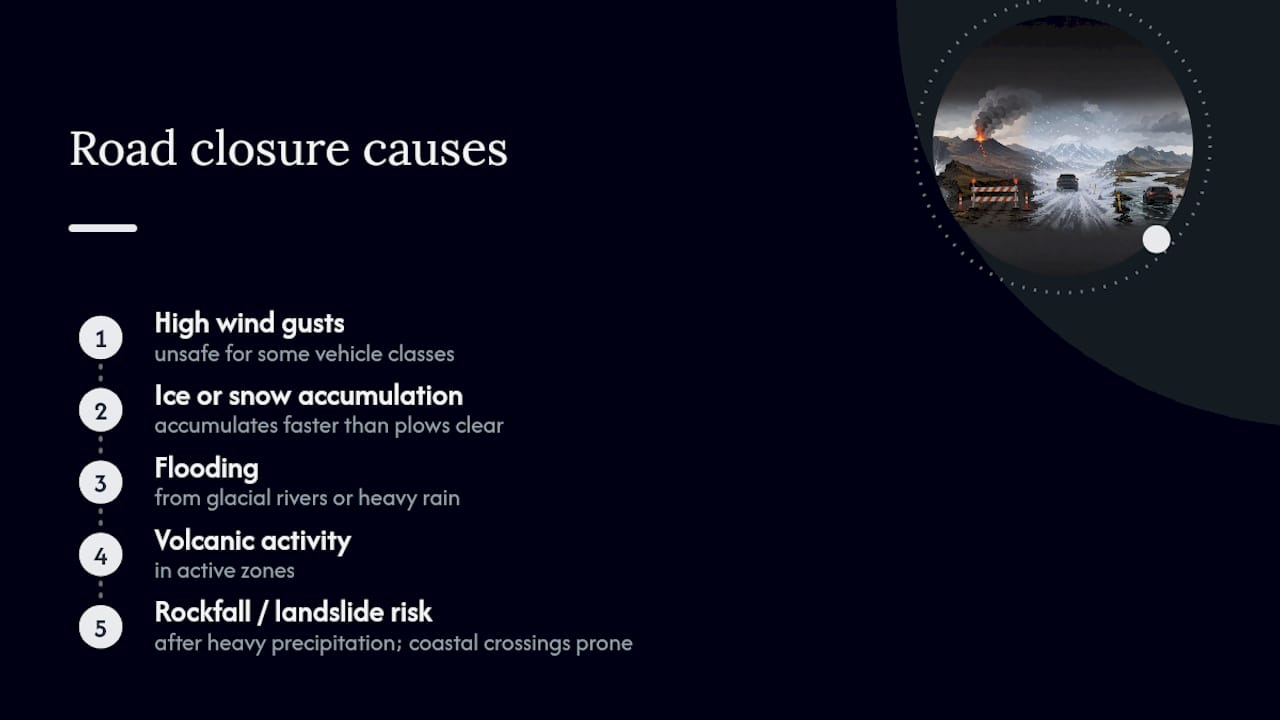
Roads close in Iceland for a shorter list of reasons than you’d think: high wind gusts that make driving unsafe for certain vehicle classes, ice or snow accumulation faster than plows can clear, flooding from glacial rivers or heavy rain, volcanic activity in active zones, and rockfall or landslide risk after heavy precipitation. Coastal segments near river crossings are especially prone to sudden closures during rapid snowmelt.
The good news is that none of these closures happen invisibly. Vegagerðin updates the live road map as conditions change, often faster than a static forecast can keep up, and the color status on your route will flip before you reach the affected segment if you’re checking regularly. SafeTravel layers on traveler alerts specifically written for tourists, which tend to explain the why behind a closure in plainer language than the technical road map does.
For advance notice rather than a same-day check, sign up for SafeTravel’s alert notifications before your trip, and get in the habit of checking Vedur.is the night before any day that involves mountain passes or the South Coast, since severe weather warnings are usually issued 12 to 24 hours ahead. If you’re staying somewhere with local staff, ask them directly. Accommodation hosts along routes like the South Coast often hear about closures from other guests or local drivers before it hits the official map.
What to Do in an Emergency or If You’re Stranded
Call 112 for any life-threatening emergency, including a serious crash, and it works nationwide, including areas with no other cell coverage nearby. Iceland’s 112 app also lets you register your location, which rescue teams can use to find you faster if you get stuck in a whiteout or off a marked route.
If you’re stranded but not in immediate danger, for example a car stuck in snow or a wind-blown door that won’t close, use SafeTravel’s feature to share your GPS coordinates directly with the 112 emergency system rather than trying to describe your location verbally. Iceland’s rural roads have few landmarks, and coordinates save critical time.
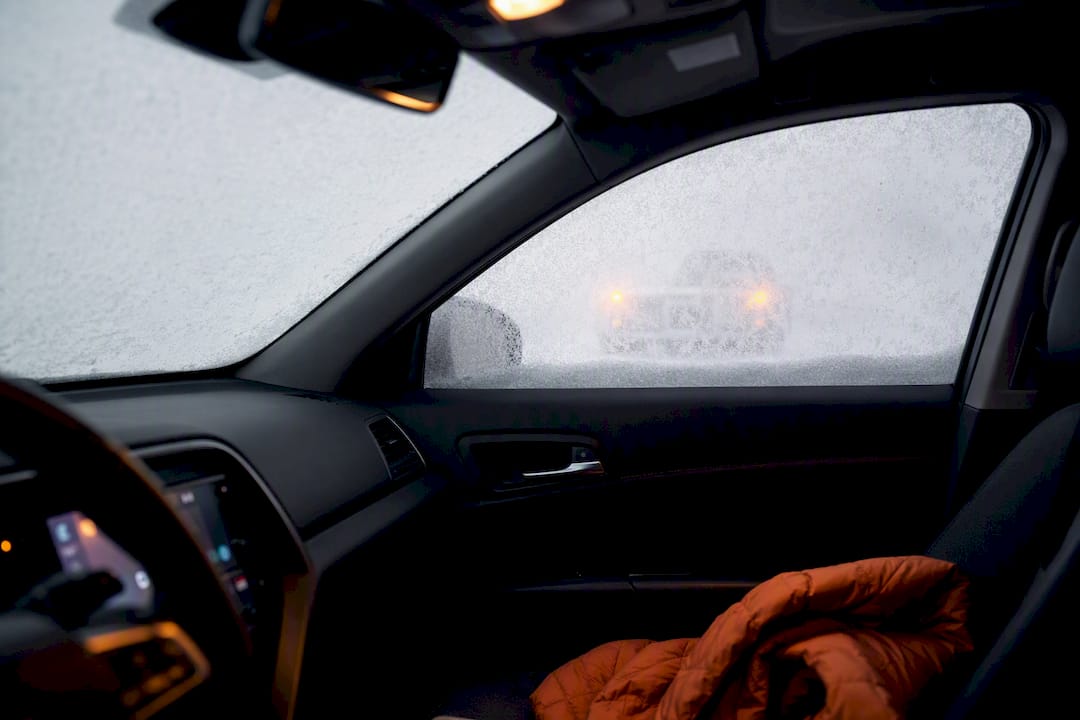
Stay in your vehicle if you’re stuck in poor visibility or high wind rather than walking to find help. Icelandic search and rescue volunteers (ICE-SAR) are trained for exactly this scenario, and a car is far easier to spot than a person on foot in blowing snow. Keep your hazard lights on, conserve fuel if you’re running the engine for heat, and let the road map’s timestamp guide your patience. Conditions on a red-flagged segment do improve, often within hours, not days.
For a rental car accident, contact your rental company’s emergency line first (it’s printed on your rental agreement) alongside 112 if anyone is injured. Document the scene with photos before moving the vehicle if it’s safe to do so, since this protects you against insurance disputes later.
Choosing the Right Vehicle for Iceland’s Roads
Your vehicle choice should match your actual route, not your budget alone. A small two-wheel-drive car is fine for the paved Ring Road in summer, but it has no business on gravel detours, highland approaches, or winter driving anywhere outside Reykjavík.
A 4x4 becomes worth the extra cost the moment your itinerary includes any F-road, and it’s legally required for them regardless of weather. Beyond the highlands, a 4x4 or all-wheel-drive vehicle also handles wind-buffeted coastal stretches and icy shoulder transitions with more margin than a standard sedan, which matters more than most first-time renters expect.
Campervans and larger vehicles need extra caution in wind specifically. Their higher profile catches gusts that a low sedan barely notices, which is exactly why the 15 m/s threshold mentioned earlier applies most directly to this vehicle class. If you’re renting one, check the wind forecast even more conservatively than a standard car renter would.
Whatever you rent, confirm what your insurance actually excludes. Gravel chip damage, sandstorm damage, and any driving on closed or F-roads are the three most common exclusion categories, and finding out about them after an incident is the worst possible time.
Public Transport Options When Roads Are Bad
Driving isn’t the only way to see Iceland, and on days when the road map is solid orange, it might not be the smart way either. Strætó, Iceland’s public bus network, runs scheduled routes connecting Reykjavík to major towns along the Ring Road, including stops accessible from the South Coast, and buses are generally better equipped and more experienced at handling marginal winter conditions than an individual tourist driver.
Organized day tours out of Reykjavík or Vík are another practical fallback. Tour operators track road and weather conditions professionally and will reroute or reschedule when a segment turns unsafe, which takes the go or no-go decision off your plate entirely on a day you’re not confident driving.
Domestic flights connect Reykjavík to a handful of regional hubs and can bridge long distances when road closures make a drive impractical, though this matters more for trips to the north or east than for South Coast day trips. For most travelers based near Vík, though, the honest answer is that flexible timing beats switching transport modes. Building an extra buffer day into your itinerary and simply waiting out a red alert is usually easier than rearranging your whole trip around a bus schedule.
Fox Hostel’s Local Take on South Coast Driving Days
We tell every guest the same thing before they head out toward Reynisfjara or further east: build slack into your schedule with a screen-free road trip plan that actually works, and check the map fresh every morning rather than trusting yesterday’s forecast. The South Coast itinerary works best with a buffer day built in, not a tight back-to-back schedule.
The Mýrdalssandur stretch east of Vík is one we watch closely. It’s a known wind corridor, and when gusts climb there, we’d rather a guest stay an extra night than push through a segment that’s flashing orange. If you’re mapping out the full loop, our seven-day Ring Road itinerary shows where that kind of flexibility pays off most.
— Siggi
A Practical Base When Road Conditions Force a Delay
Some days the road map makes the decision for you, and being stuck near Vík is a far better problem than being stuck on a closed pass. Fox Hostel sits about 35 minutes east of Vík in Hrífunes, which means a delayed South Coast day still leaves you close to fuel, food, and the next morning’s route check rather than backtracking hours out of your way.

If wind or ice pins you in place for a night, a communal kitchen means you’re not stuck hunting for an open restaurant on a stormy evening, and secure parking gives you one less thing to worry about while gusts pass through. Solo travelers can book a single bed in a dorm, while couples, families, or groups can book an entire room for privacy. Check current room availability for your dates, or browse the full range of rooms and dorms to build a flexible night or two into your South Coast plan before the weather makes that choice for you.
Sources
For closures and live status, use Vegagerðin’s road map. For traveler alerts and emergency GPS sharing, use SafeTravel. For wind and weather warnings, use Vedur.is. For a combined dashboard with webcams, try road.is or icelandroads.com. For emergencies, call 112.
- Traffic Info
- Travel conditions - Safetravel
- What are F-roads in Iceland? (GoCarRental)
- Winter driving in Iceland (Map of Iceland)
FAQ
What roads are closed in Iceland today?
Closures change daily and sometimes hourly, so the only reliable answer is the live road map at umferdin.is, which shows current status by segment rather than a fixed list.
What is the best app to check road conditions in Iceland?
Vegagerðin’s Traffic Info (umferdin.is) is the official source for closures and colors, while SafeTravel adds traveler-specific alerts and an emergency GPS feature, so most drivers use both together.
Is it still safe to travel to Iceland right now?
Iceland is safe to travel year round as long as you check road and weather status daily and adjust plans around orange or red alerts rather than driving through them.
Is it hard to drive in Iceland as a tourist?
Iceland’s roads are straightforward for confident drivers, but wind gusts, black ice on bridges, and unfamiliar gravel and single-lane bridges catch out tourists who don’t check conditions each morning or don’t slow down for posted hazards.