Vík to Dyrhólaey Sunrise: Arrive 30–45 Minutes Early
Vík to Dyrhólaey Sunrise: Arrive 30–45 Minutes Early

For sunrise at Dyrhólaey, head to the upper lighthouse viewpoint for a full panorama of the arch and coastline, or choose Reynisfjara beach if you want the arch silhouetted against the sea. Check seasonal closures before you leave, and arrive 30 to 45 minutes before sunrise so you catch the color building in the sky.
TL;DR:
- Without four wheel drive, or in wet or winter conditions, use the lower lot; the lighthouse walk is about 1.3 kilometers each way.
- Nesting closures run from mid May to late June, but dates and daily access vary; check before leaving and use Reynisfjara if needed.
- Leave Vík 75 to 90 minutes before sunrise to cover the drive, parking, and the lower lot’s 1.3 kilometer walk each way without rushing.
- For landscape detail, use low ISO, f/8 to f/11, and exposure bracketing; switch to handheld shooting if gusts shake your tripod.
Table of Contents
- Best viewpoints: lighthouse vs. Reynisfjara, which to choose for sunrise
- Timing: first light, golden hour, and exact sunrise times for Vík
- Access, parking, and walking routes: upper and lower lots, 4WD advice, and distances
- Sunrise photography tips for Dyrhólaey: gear, settings, and composition
- Wildlife and seasonal closures: puffins, nesting season, and respectful visiting
- Safety and etiquette: cliff edges, wind, and staying on trails at dawn
- Practical timing: sample mini-itinerary from Vík for a smooth sunrise visit
- Fox Hostel local tips and helpful local links
- Author perspective: quick local note from Siggi at Fox Hostel
- Book a nearby stay at Fox Hostel for easy sunrise departures
- FAQ
- Sources
Best viewpoints: lighthouse vs. Reynisfjara, which to choose for sunrise
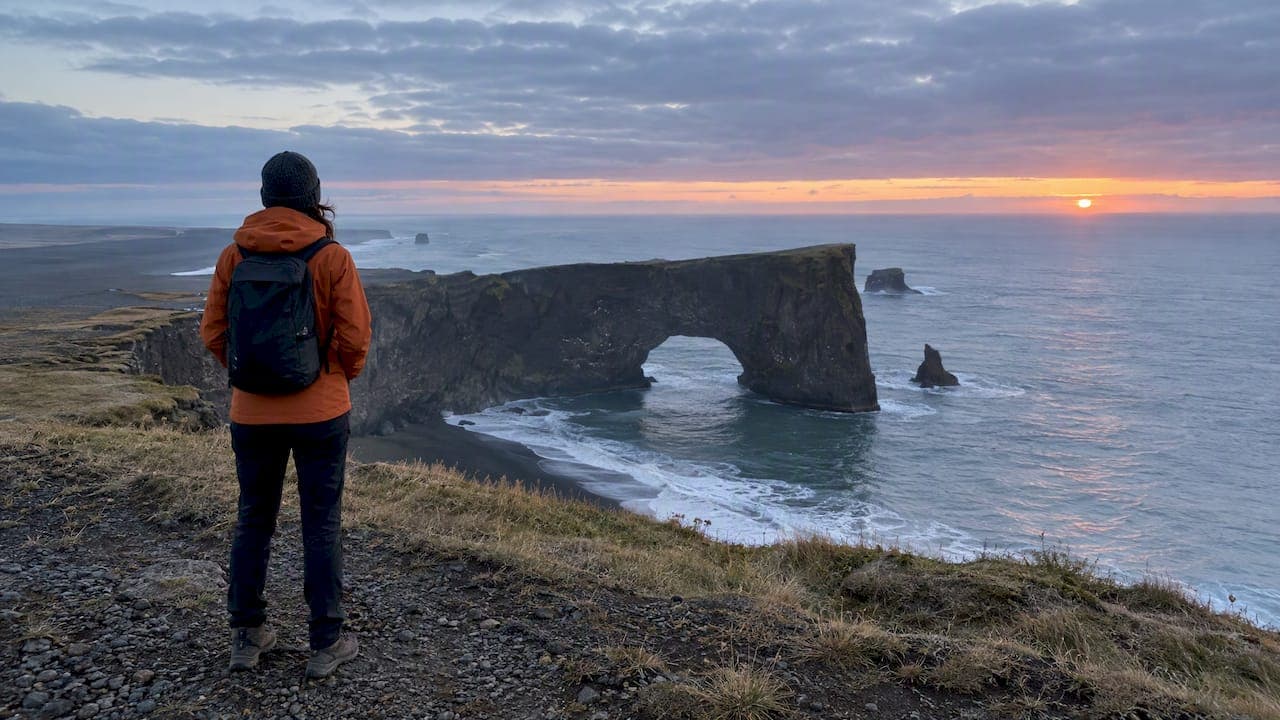
The upper lighthouse viewpoint sits near the top of the headland and gives you a sweeping view in several directions at once: the famous arch below, the black sand stretching toward Reynisfjara, and on clear mornings the outline of Mýrdalsjökull glacier inland. The lighthouse itself, perched at roughly 120 meters, makes a strong silhouette against a pink or orange sky.
Reynisfjara beach gives you a lower, more intimate angle: the arch framed against black sand and the sea stacks of Reynisdrangar rising offshore. Many photographers favor this perspective for a cleaner, more dramatic composition.
- The upper lot is more exposed to wind, so tripod stability takes more effort.
- Reynisfjara offers some shelter near the cliffs but still gets strong gusts off the water.
- Choose the lighthouse for a panoramic shot; choose the beach for an intimate arch silhouette.
Casual visitors who want one memorable view with minimal walking tend to prefer the lighthouse. Photographers chasing a specific composition often split their morning between both spots.
Timing: first light, golden hour, and exact sunrise times for Vík
First light is the faint glow that appears in the sky before the sun actually rises, and it is often when the color show begins. Sunrise is the moment the sun crosses the horizon, and golden hour stretches for a while after that with soft, warm light that flatters landscape photos.
- Use a date-specific sunrise calendar rather than a general rule of thumb.
- Plan to arrive 30 to 45 minutes before sunrise to catch first light building.
- Adjust earlier in summer, when sunrise comes very early and the window is tighter.
Looking up exact times matters more than guessing. On October 6, first light near Vík starts around 6:51 am and sunrise follows around 7:38 am, according to the Vík sunrise and first-light calendar. That roughly 45-minute gap between first light and sunrise is your working window for the best sky color.
Access, parking, and walking routes: upper and lower lots, 4WD advice, and distances
Dyrhólaey has two parking areas, and choosing the right one depends on your vehicle and the weather that morning.
- The lower lot sits near the base of the headland and is accessible to any car, with a walking distance of about 1.3 km one way up to the lighthouse viewpoint.
- The upper lot sits right by the lighthouse but is reached by a steep gravel road that frequently develops potholes, according to Visit South Iceland.
- Without 4WD, or in wet or winter conditions, parking at the lower lot and walking up is the safer choice, a point echoed by Lonely Planet’s overview of the site.
- Restrooms and marked trails are near the lower lot, and some access points have limited hours during parts of the year.
- Before heading out in the dark, check Road for live road and weather updates, since conditions on the gravel ascent change quickly.
Sunrise photography tips for Dyrhólaey: gear, settings, and composition
Wind and blowing sand are the two things most likely to ruin a sunrise shoot here, so plan your gear around them.
- Bring a wide-angle lens for the coastal panorama, a mid-weight tripod, something to block wind off your setup, and spare batteries since cold drains them fast.
- Shoot at a low ISO with an aperture around f/8 to f/11 for sharp landscape detail, and bracket your exposures to handle the bright sky against darker cliffs.
- A longer exposure smooths the waves at Reynisfjara into a soft blur, which works well with the arch as a static anchor.
- Weigh down your tripod legs with a bag if the wind picks up, and switch to handheld shooting if gusts make the tripod shake.
Foreground texture carries a lot of these shots: black sand ripples, scattered pebbles, or tufts of coastal grass all add depth when the arch or lighthouse sits in the background. Wind can push sand into your gear quickly at dawn, so keep lenses covered and camera bags closed until you’re ready to shoot, a caution also raised by Visit South Iceland.
Pro Tip: Pack a microfiber cloth in an easy-to-reach pocket. You’ll use it more than any other item in your bag.
Wildlife and seasonal closures: puffins, nesting season, and respectful visiting
Parts of Dyrhólaey are protected as a nature reserve, and sections close seasonally to protect nesting birds, typically between mid-May and late June, though exact dates shift from year to year.
- During nesting season, some areas open only during limited daily hours, so check before you plan an early departure.
- Stay well back from marked boundaries and avoid approaching birds, even for a closer photo.
- If the upper areas are closed, shift your plan to Reynisfjara, which Visit South Iceland notes can offer a more photogenic view of the arch and stacks anyway.
If puffins are part of your trip, our guide to seeing puffins near Vík covers a shorter, self-guided route that works well alongside a sunrise visit.
Safety and etiquette: cliff edges, wind, and staying on trails at dawn
Dyrhólaey’s cliffs are high, exposed, and often windy enough to catch you off guard in the dark. Stay on marked trails, keep a clear distance from any cliff edge, and skip shortcuts across grass or rock that look tempting in low light.

Wind can shift suddenly on this headland, so dress in windproof layers and secure anything loose, including camera straps and hats. Bring a headlamp for the walk in before sunrise. Respect closure signs and stick to the reserve’s paths: it protects both you and the birds that nest there.

Practical timing: sample mini-itinerary from Vík for a smooth sunrise visit
A simple schedule keeps the morning low-stress.
- Check sunrise time and road conditions the night before and again when you wake up.
- Leave Vík about 75 to 90 minutes before sunrise to allow for the short drive, parking, and the walk if you choose the lower lot.
- Park at the lower lot in winter or wet weather, or the upper lot in dry summer conditions if your vehicle handles gravel well.
- Walk the 1.3 km route with time to spare, then settle in 20 to 30 minutes before sunrise to set up gear.
- Shoot through golden hour, then head back for a warm breakfast.
In summer’s near-constant daylight, timing is more relaxed; in winter, allow extra buffer for ice and darkness, or consider a warming retreat like a restorative stay in the Swedish countryside. Pack a thermos and warm gloves either way, since standing still on an exposed cliff gets cold fast. For a longer regional plan, our South Iceland itinerary guide lays out a few day-by-day options around Vík.
Fox Hostel local tips and helpful local links
We’re based close to Vík, which makes an early sunrise departure simple rather than stressful, and breakfast on site means you can fuel up before heading out or warm up right after. For deeper route notes, our Dyrhólaey lighthouse walk guide covers walking times and closure notes in more detail, and it’s worth a check the morning of your visit in case conditions have changed overnight.
Author perspective: quick local note from Siggi at Fox Hostel
Having watched plenty of sunrises over this coastline, I’d say the lighthouse view wins for a first visit, but Reynisfjara deserves a second trip of its own. Check the road and closure status before you leave, and don’t let a locked gate turn into a wasted morning: Reynisfjara is always a strong backup.
— Siggi
Book a nearby stay at Fox Hostel for easy sunrise departures
A sunrise shoot works a lot better when you’re not driving an hour in the dark beforehand. Staying with us puts you a short drive from Dyrhólaey, with breakfast available early enough to fit around a dawn departure and a warm bed waiting when you get back.

We offer both shared and private dormitories for solo travelers, couples, and groups, and our group booking option works well for anyone planning a sunrise trip with friends. Check availability and book your room for your South Coast sunrise visit.
FAQ
How long should you spend at Dyrhólaey?
Plan for one to two hours if you’re walking between the lower and upper lots and shooting sunrise, including setup and wind-down time. Add extra time if you want to visit Reynisfjara the same morning, since the two spots are a short drive apart.
What time is golden hour in Iceland?
Golden hour starts around sunrise and lasts roughly 30 to 45 minutes afterward, though the exact timing shifts with the season. Checking a date-specific sunrise calendar for Vík gives you the precise window for your visit.
Can you see the northern lights near Vík?
Winter nights near Vík, with low light pollution and clear dark skies, offer good conditions for viewing the northern lights when solar activity cooperates. Visibility depends heavily on cloud cover and the aurora forecast for that specific night, so check conditions before heading out.
What time of day is best for Sky Lagoon?
Sky Lagoon is located near Reykjavík, well outside the Vík and Dyrhólaey area covered in this guide, so specific visiting hours fall outside what we can speak to here. For a South Coast sunrise trip, your morning is better spent at Dyrhólaey or Reynisfjara before the light changes.
Sources
- Dyrhólaey: Cliffs, Puffins & Views in South Iceland | Visit South Iceland
- Dyrhólaey | Attractions - Lonely Planet
- Vík í Mýrdal Sunrise and Sunset Times
- Traffic info | Icelandic Road and Coastal Administration